Search This Blog

Showing posts with label cooking. Show all posts

Tuesday, June 25, 2024

Finally getting around to that chutney....


I got out the jars and everything at the beginning of the week, but every evening I was too tired, so it was Friday already when I finally got the rhubarb-mango chutney together. Love the aroma of vinegar and spices in the house! You can look online for a recipe that appeals to you or simply make up your own. Chutney, I've found, is very forgiving. And if anyone in Northport needs mustard seeds, let me know. Somehow I managed to accumulate three containers so am more than willing to send two of them to new homes.


Monday, May 6, 2024

Spring Fever -- Go Wild!


Dandelions,leeks,toothwort, violets


Fiddleheads in the woods

Outdoors every day, anyway, keeping track of what Nature is up to, why has it taken me so long to begin foraging? The extent of my wildness in past years has been to add toothwort leaves and edible flowers to ordinary salads. I never tried dandelion greens before. And fiddleheads are a whole new world for me: if I'd known how delicious that little dish would be, I'd have brought more home! Next year....

Salad with carrot shavings added


Sautéed fiddleheads with yellow violets


Friday, February 4, 2022

So Good, It Doesn't Need Meat


Getting Started

Curried cabbage soup, made with coconut milk, sounded good to me when the thermometer went down below freezing. As is true of so many wonderful winter dishes, the soup begins (on the left above) with onions, garlic, and fresh ginger. In a saucepan, sliced carrots simmered in chicken broth (I use Better Than Bouillon; see this post on cauliflower soup) until it was time to add a can of diced tomatoes and let those flavors simmer together. 


All together now!


Aromatics added to the broth-carrot-tomato mixture in the saucepan, it was time for spices -- curry and turmeric. More simmering.... Stir in the coconut milk. And then, at last --.


Chopped cabbage will steam and simmer, blending into the base.

With the addition of cabbage, our soup is complete. How long you simmer it depends on how soft you like your cabbage and how hungry you are. 


Some recipes for curried cabbage soup call for chicken, but frankly, I don't see the point. This is such a flavorful soup that chicken would get lost in the crowd. And you can always ladle cooked-down, leftover soup over rice and serve it next to chicken, if you like, the next day.

Perfect soup!


Monday, February 22, 2021

Why Bother With Cookbooks?

Not a pepper, after all! See postscript.

 Some people don’t. Don't bother with cookbooks, that is. Isn’t everything on the Internet, and aren’t all the recipes your heart could ever desire a couple taps away on your phone?


No, not everything is online -- someone had to upload it, or it isn’t there – but yes, there is probably more at your fingertips than you’ll ever look at, let alone use, which brings us back to my original question, and if you’ve already decided to “bother” with cookbooks no longer, I’m probably not going to convince you otherwise. Don’t they take up precious space that could better be used for cookware? Aren’t they really just – clutter? Since I grew up in a family of readers (as well as a family of letter-writers, but that’s another story), as long as I live I will never see books as clutter. 


(When in my early teens I baby-sat for neighbors, the most challenging job was in a house that contained no books. Not a one. There was a TV Guide and a Victoria’s Secret catalog. That was it. On that job, I occasionally did homework but basically watched a lot of television, clear through to the channel sign-off signal -- something that no longer exists. But the young couple, parents of a madcap little Dennis the Menace, stayed out late and they paid well.)


So what I’m getting at, in my usual roundabout way, is that cookbooks for me are books first, recipe collections second. I like it best when they either have photographs or give me paragraphs – preferably pages! – of thoughtful prose, and if the author offers me both, that is a dream book. 


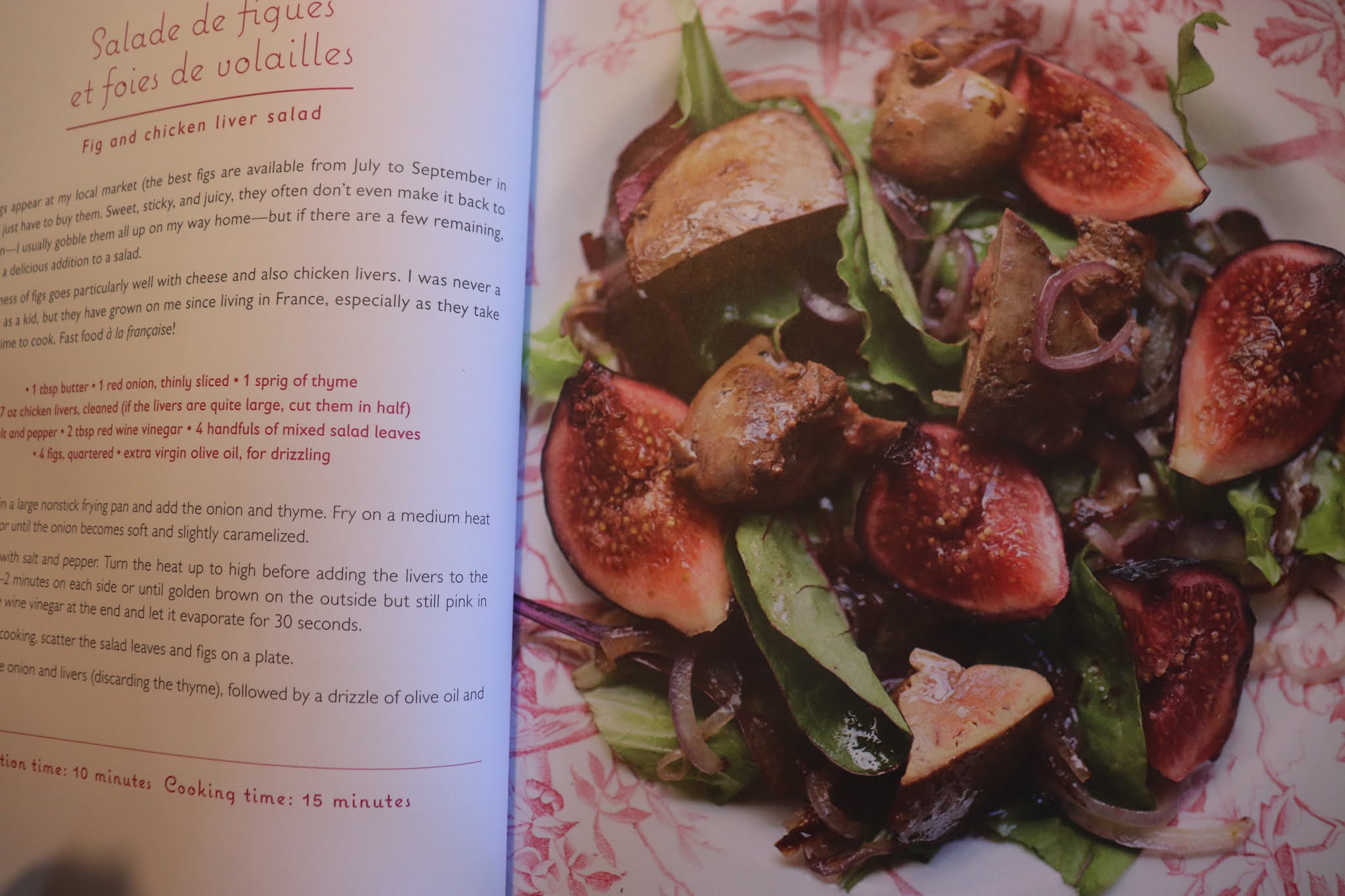
The first recipe in Rachel Khoo’s The Little Paris Kitchen (and how could I possibly resist a book with that title? I ask you!) is for a salad of fresh figs and chicken livers. Rather than diving directly into instruction or a list of ingredients, Rachel muses as follows: 


When figs appear at my local market (the best figs are available from July to September in France), I just have to buy them. Sweet, sticky, and juicy, they often don’t even make it back to my kitchen – I usually gobble them all up on my way home – but if there are a few remaining, they make a delicious addition to a salad. - Rachel Khoo


Oh, be still, my heart! Fresh figs! Growing up in the Midwest, I knew only dried figs and the cookies known as fig bars. When our hostess in the Ardèche offered me a fresh fig right off her tree and I bit into it, I burst into tears! Looking at the photograph of Khoo’s salad, I taste the sweetness and feel the graininess of the seeds in the fruit pulp, and I would give anything for a fresh fig!


Alice Waters, besides being the sister of a good friend, inspires me. Alice does not preach precision. She gives a basic idea and then encourages her cookbook readers to make substitutions and try variations. She writes: 


Flexibility is an essential component of good cooking. You should never feel locked in to a recipe or a menu unless it involves a basic principle regarding procedure or technique such as those involved in breadmaking and pastry. I don’t ever want to write anything in this book that is so precise that the reader must invoke great powers of concentration on every last detail…. 


…When you are faced with the absence of a certain ingredient, don’t panic; formulate your own acceptable or inspired replacement….

- Alice Waters


Isn’t that dear of her? To give us hope that our substitutions may be “inspired”? Oh, thank you, thank you, Alice!


It's always good to have one or two basic cookbooks on hand, and the basic cookbook I have here in Arizona is Irma Rombauer’s Joy of Cooking. (Back in Michigan I have three or four different basic books, one of them a reprint of the one I grew up using in my mother’s kitchen.) It seems I’m always looking up proportions for simple things like noodles or muffins or a conversion chart for measurements. Things like that. 


I must say, however, that Joy let me down recently when Rombauer wrote (and I believed) that “stone-cold” pans could be used for popovers. Not true! I have a whole story to share about popover failure, but that must wait for another day….


Here in our winter ghost town, I have only one shelf for cookbooks, not a whole bookcase as I have back in Michigan, so there are days when an addition to the shelf prompts me to consider de-acquisition of something else. Tough choices! 


In the Southwest, a Mexican cookbook is a must, isn’t it? So I was happy to add this one to my shelf. But will it surprise you when I say that Rick Bayless’s Mexican Kitchen: Capturing the Vibrant Flavors of a World-Class Cuisine is more intimidating to me than any of my French cookbooks? Basically, it’s the peppers. There are so many of them, and their names change when they are dried (as grape becomes raisin, poblano becomes ancho), and the true Mexican cook is not only a master of capsicum but of so much more!


The other day, though, at last I roasted a pepper over a gas flame on the stove, something I’ve been intending to try for years and finally got my courage up to attempt. Blistered the skin, let the pepper cool, scraped off the skin, scraped out the seeds, and chopped up that pepper to add to chopped fresh tomato, white tomato, onion (Mexican cooks prefer the white, I learned from Bayless), and garlic. The pepper I roasted (what was its name???) was not particularly hot, so I did add a few drops of hot sauce. And my salsa was good! So I made a start, at least. Baby steps….


Then, last year I found and bought a German clay cooker, and this year I found the cookbook to go with it! Serendipity! That should help me get back to experimenting with “ancient pot” cooking, because my clay cooker has been feeling rather neglected, I know. A whole book, not just one online recipe at a time.


And just on the heels of a gout attack in our household (I was not the victim), which led me to think we should eat less red meat and more chicken, a visit to the FOL bookstore over in Pearce/Sunsites turned up this book: 


What could be more timely or more inspiring? I am excited already, having only looked through a dozen pages! 


Inspiration. Encouragement. Memories. Pleasure. That’s what I find in cookbooks. I can’t imagine my life without them.


IMPORTANT POSTSCRIPT! My sister reminds me that the catalog at the bookless household was Frederick’s of Hollywood. Victoria’s Secret did not yet exist. (That shows our age, doesn't it?) Then, a very savvy foodie friend set me straight about chiles and peppers: they are not the same genus! See an explanation here. 


So much to learn — at least I had that right!


Friday, January 1, 2021

A Successful Year-End Experiment


Rather than saving the end result for the finale, I’m revealing it here right up front. This was my version of savory clafoutis featuring ham and leeks. 


The classic clafoutis comes from the Limousin region of France and features unpitted fresh black sweet cherries. I hadn’t realized there were so many variations, but then, it’s possible that Christophe Felder, the well-known French pâtissier, invented the many versions in his book, Clafoutis de Christophe. At any rate, the two major divisions are sweet clafoutis (sucrés) and savory (salés), the latter particularly intriguing to both human members of our household and a completely new idea to me.


With so many mouth-watering variations offered, it was hard to choose which to try first. I leaned toward ham and leeks, since we like both. I also liked the attractive bundles of slivered leeks wrapped in slices of ham but thought the ham was not quite in scale (it looked somewhat gross and heavy, even in the beautiful color photograph) and that prosciutto would be better – thin slices of meat, slender slivers of leak. But my quarantine kitchen partner vetoed prosciutto (“too fatty,” he says), so I compromised by cubing the ham and slicing the leeks into rounds, more in the style of the Clafoutis poireaux et lardons.


Using this cookbook presented multiple challenges. (1) To begin with, every word is in French, and there were words whose meaning I had to seek in a dictionary, e.g., chapelure. Would you have known that one? (2) Second necessity was that of converting metric measurements to American. Twenty-five centileters = 1 cup; 150 grams = 2/3 cup; etc. (3-4) Then there was oven temperature, which I had to convert from Celsius to Fahrenheit and adjust the Fahrenheit temperature for high altitude – and I cannot tell you how many times I calculated and checked and re-checked the oven temperature for my clafoutis until finally, after a careful search through many recipes in the book, I realized that the savory recipes required baking at about 100ºF higher than the sweet recipes. 


I guess there was a small fifth challenge, as French crème fraîche is not readily available in the U.S. While it is possible to make a substitute, using sour cream or buttermilk or yogurt, I was happy to find crema Mexicana locally, which fit the bill to a T. One cup of crema, one cup of milk (I used evaporated milk straight from the can), two whole eggs, and two egg yokes, beaten together with slightly less than 2-1/2 teaspoons (10 grams) cornstarch, and this, with the addition of salt and pepper, is poured over the ham and leaks in a baking dish that has been buttered and dusted with fine crumbs. The next time I try a savory clafoutis I’ll add grated Parmesan to the fine crumbs, because that crispy crust could only be improved by cheese flavor. 


Freshly grated nutmeg was my idea, and that was, if I may be so immodest as to say so, an addition of genius. 


After thirty to forty minutes in a hot oven (425ºF here in the mountains), the dish puffs beautifully. It has the lightness of a souffle and yet the smooth texture and richness of a baked custard – which is what made the nutmeg dusted on top even more appropriate than I imagined when the idea came to me.


Remember that fresh, uncooked, spicy cranberry-walnut relish from Christmas dinner? Cold and crisp, it was an ideal complement to the hot savory custardy main dish.


I feel so much like Julia Child (a rare feeling for me) in offering this recipe to you (well, it is actually Christophe Felder’s offering, not mine, but I, like Julia, have made it available to American cooks) that I can only close today by echoing Julia: “Bon appétit!”


Monday, December 28, 2020

Christmas Dinner Leftovers, Day 2


Leftover Dinner Day 1 was shredded pork tossed with a mix that one would use as a rub before roasting if making the pulled pork completely from scratch. We had the pork roast for Christmas dinner. The next day I shredded a small pile of the leftover meat and tossed it with brown sugar, ground coffee beans, salt and pepper, paprika, cumin, coriander, and ground cloves, then put it in a casserole dish with a small amount of water and let it all "get good together" (as my grandmother used to say) in a slow oven for about three hours. Served on tortillas, it received added oomph from one of our Christmas gifts, pepper and onion relish. 

Day 2 was simpler and faster and really needs no  explanation, as the pictures here tell it all.


Monday, April 6, 2020

Quarantine Kitchen: A Sauce That Goes With Everything (Except Maybe Dessert)

Do you know what this is?

I’ve decided not to number each dish or recipe or even each Quarantine Kitchen post individually. What if the numbers reached triple digits? That would be disheartening, wouldn’t it? So I’ll just go along from now on, one day at a time, combining more than one experiment into each post. Today, for example, I have to report one blazing success, one save, and one near-complete flop. I’d call that last a complete flop, except that my quarantine partner was happy with the results, and we did eat them. First, however, the success.

“What is it?” neighbor Therese asked during our walk with dogs, when I told her neighbor Dorothy had suggested I make a batch of chimichurri with parsley from her, Dorothy’s, greenhouse. I’d never heard of chimichurri before and was reminded of a song from the “Mary Poppins” (the movie) sung — well, performed — by Dick Van Dyke. 

I packed that quarter-cup measure full

When you look up chimichurri, as I know you will and I encourage you to do, you’ll learn that it is an Argentinian sauce, used as often in Argentina as red and green salsa are here in the borderland, though it has more in common with Italian pesto. You’ll also quickly realize that there is great controversy about which ingredients may be included, which must be, and which would make any self-respecting Argentinian roll over in his or her grave. For instance, one recipe I read online got five stars and raves in the form of “I love this recipe!” from several readers, while others were outraged and said it was “not chimchurri at all!”

Maybe mine was "not chimchurri at all" — who am I to judge? — but I can tell you that we loved it!


I have no food processor but am now possessed of a simple blender, and that would have to do. Chopped fresh parsley (1/4 cup), chopped garlic (4 big cloves), balsamic vinegar, salt, crushed red pepper, and oregano went into the blender. 

Right from the start, though, I had to make adjustments in the basic recipe I'd chosen to follow: (1) With no red wine vinegar on hand, balsamic vinegar would have to do; however, it is a very strong-flavored vinegar, so (2) I reduced the three tablespoons to two tablespoons and added a tablespoon of water to make up the difference. Also, (3) as I had no oregano leaves but only ground oregano (oregano molido), I cut that amount in half as well. (4) Olive oil was to be added only when the parsley mixture went from food processor to bowl, but in my case, as it began in the blender I added some of the olive oil then and there, for the sake of consistency. 

Getting all that in the bowl at last, I added the remainder of the olive oil, after which it had to sit 10 minutes before being stirred. The suspense was nerve-wracking! After stirring and a tiny, tentative taste, there was still the suspense of how the sauce would work to complement the evening’s chicken. 

With olive oil floating on top before stirring

The photo at the top of the screen today is the final product. 

I neglected to photograph the plated dinner but can report that the the sauce was delicious not only on the chicken but also on the sweet potato and steamed broccoli! And that the following evening it brought a fresh tomato salad to sparkling life! Dorothy tells me it’s good simply spread on bread, so there’s something we can try in the days ahead.

Chimichurri — resounding success in the quarantine kitchen and something that will spark up our meals for, I hope, many years to come!


Something else, an experiment that was disappointing on the first day, turned around and became (surprisingly) glorious by the second. I had been preparing an entire post on bananas and how there’s more you can do with them than make banana bread. For example (and I have photographs for these), banana pancakes. For a more obvious example, fruit smoothies.

Handy new blender again
I make my own yogurt at home during the months my bookstore is closed, but one of the tricks of making yogurt is to avoid ultrapasturized milk. Sadly, the last time I shopped, all I could find was ultrapasteurized. What would happen? I tried and found out. The yogurt did not set up but had a runny, gooey, gluey consistency. Oh, well, I could put it on my granola, couldn’t I? And how could it hurt a fruit smoothie?

Substandard homemade yogurt, a couple of very ripe bananas, mango-coconut juice, a handful of blueberries and a handful of raspberries from the freezer all went into the blender. The result was drinkable. The taste was all right. The consistency, however, was disappointing. Not like a smoothie at all. My quarantine partner (known in my main blog as the Artist) turned down the offer of a disappointing smoothie, and I couldn’t blame him at all.

Not the best I've ever made
But waste not, want not. I am my grandmother’s daughter! Into the fridge it went. And lo and behold! The next day the consistency and texture had undergone a transformation! My smoothie (and it still tasted good) had become rich and thick and velvety smooth. Very satisfying!

A miracle!

I’ll note one more experiment but without a single image and without detailing the foolish improvisation I made that led to failure. The experiment was cheese popovers. Cheese popovers were one of my mother specialties, and for years someone has entreated me to make them for him. Okay, it felt like the time had come. We needed a treat. Long story short: they didn’t pop. I have figured out what I did wrong, though, and the next time will be a success — with pictures.

Thanks for visiting. Hope you are managing to enjoy a few experiments in your quarantine kitchen. -- I should say "sheltering-in-place kitchen" but the sound works better with the stronger word.