Search This Blog

Showing posts with label baking. Show all posts

Monday, December 27, 2021

Save Those Cookies!


Hard to believe I haven't posted anything here since April. Okay, maybe not so hard to believe. There were last weeks in the ghost town, travel back to Michigan, months of bookselling and mowing grass, then packing up to come back to the high desert. I haven't been filled with ambition since we got here, either, not for cooking or baking or much of anything but reading and walking with dogs.


I did, however, get it together to mix up a couple batches of cookies before Christmas and want to share a tip that others might find helpful. The first batch of mincemeat cookies I pulled from the oven were not, as it turned out, quite done. I went ahead with the rest, then turned the oven off, and put the not-quite-done cookies back on a cookie pan and in the oven. Remaining heat took care of the problem. In fact (and this might be going further than necessary), I didn't pull them out of the oven until the next morning, when they were crispy and delicious and not at all overdone. 

Mincemeat cookies have a yummy taste but are an easy drop cookie to make and don't need decorating to be festive. Sorry I did not take enough photos to document the problem and solution, but as you can see by the nearly empty bowl, everything worked out fine. This solution just might work with any kind of drop cookie. Let me know if you run into the problem with another kind of cookie and solve it with my fix.


Sunday, April 18, 2021

Try It, You’ll Like It: My Nontraditional Madeleines


Only a small amount of chocolate needed

Friends were dubious. Their first response was that substituting orange zest for lemon sounded fine, but they drew back in horror at the idea of chocolate. Nevertheless, she (I) persisted. What is cooking and baking without experiment or risk? This is, after all, a pretty small risk in the larger scheme of life. 


So here are the ingredients and amounts I used, which you would be wise to double, since I had cut the original traditional recipe in half before trying it the first time and just stuck with that for my variation. See previous post (here) for details of original attempt at madeleines. 


1 cup sifted flour 

½ cup fine sugar

salt

½ cup melted butter

2 eggs

½ tsp. vanilla

zest of one large orange

½ oz. baking chocolate


The small amount of chocolate doesn’t even have to be heated on the stove. When the butter is melted, just pull that little saucepan off the fire, add the chocolate, and stir. It will melt quickly.


You may be tempted to increase the amount of chocolate. Don’t. At least, that is, well, do what you want, but I recommend the small amount given here. You don’t want chocolate to overpower the orange flavor, nor do you really want a “chocolate cookie” result. Do you?


Sorry there is no photograph here of the results. I was making the chocolate-orange madeleines for a neighbor as a get-well gift and only kept four for us, which we ate immediately after dinner and before I could even think about grabbing my camera. We loved them. What more need I say? 

Tuesday, April 6, 2021

Madeleines: Who Says They’re “Tricky”?

The pan, or mold, is essential.


The essential baking pan with its shell-shaped creusees traveled with me from Michigan to Arizona in November, so there was no reason my first attempt had to wait until April. Was I intimidated because by the reputation of these iconic French dainties, famous not only for their origin but legendary for the literary role played by a madeleine dipped in tea by the narrator of Proust’s Remembrance of Things Past, the taste of which brings back a rushing flood of childhood memories?


Not exactly a cookie, and not anything I would call a pastry, either, the darling little tea cake’s richness is belied by the simplicity of the ingredients. At least one online recipe source, however, referred to the making of madeleines as “tricky.” Luckily, I was spared that added anxiety, as I did not look online at recipes until after having done the deed – and only then to provide a link on Facebook for friends unfamiliar with the madeleine. My own preparatory research was faster and more direct: Prosper Montagne’s Larousse Gastronomique: The Encyclopedia of Food, Wine and Cookery


More than a cookbook, Larousse Gastronomique provides history of various foods and food-related items, all arranged in alphabetical order. Was the inventor of the madeleine Prince Tallyrand’s pastry-cook, or were they known earlier, first made in the town of Commercy? Certain it is that Commercy long guarded its “secret recipe” for madeleines, the specialty that put the town on the map of France, and Montagne gives two recipes, that for a madeleine de Commercy and another for a madeleine ordinaire. You might say I used both, because what I did was to cut in half the proportions given for the ordinary madeleine and add the lemon zest from the Commercy version.


Recipe:


And so, to ½ cup of sugar, 1 cup of sifted flour, a pinch of salt, two eggs, and ½ teaspoon of vanilla (amount not specified, but that’s what I used) I added ½ cup melted butter and the zest of one lemon. (Use your own judgment, but I let the butter cool slightly rather than pour it directly into the flour and egg mixture as soon as it was melted, not wanting to have a bowl of floury scrambled eggs on my hands.) Tip: If you find yourself in someone else’s kitchen and don’t have a flour sifter, spoon the flour into a fine-mesh strainer and jiggle it through by hand. It works just fine.


substitute sifter

smooth batter

before...


The resulting smooth batter is then spooned into buttered and floured molds and popped into the oven at 375 degrees for 15-20 minutes. I let them cool before popping them out of the pan. Perfect!


Variations:


Powdered sugar can be sieved over the warm tea cakes before serving, but I chose not to gild the lilies this time around. I may do so another time. And here’s a possibility from the baker who warned of potential failure: Carefully bring the butter past simply melted all the way to browned, and your finished tea cakes will be darker in color and perhaps with a somewhat nutty flavor. Try it and let me know. You do have to watch the butter every second to ensure it does not go past browned to burnt.


Actually, what I have in mind to try sometime is orange instead of lemon zest and a small amount of dark chocolate (!) melted with the butter. Does that sound like heresy? What would Proust say? It would certainly not be a classic madeleine, but something tells me it might be delicious. The "ordinary" ones certainly are. 


P.S. We all have our "madeleine moments." Here's one I wrote about on an earlier occasion.


P.P.S. Here is the subsequent chocolate story.

Sunday, January 17, 2021

Pizza Re-Run: Two Crucial Secrets

pizza dough on the rise

It’s worth doing. If yours is a small household, bake only one pizza at a time from the dough recipe. Shape and pre-bake the second to go in the freezer.  

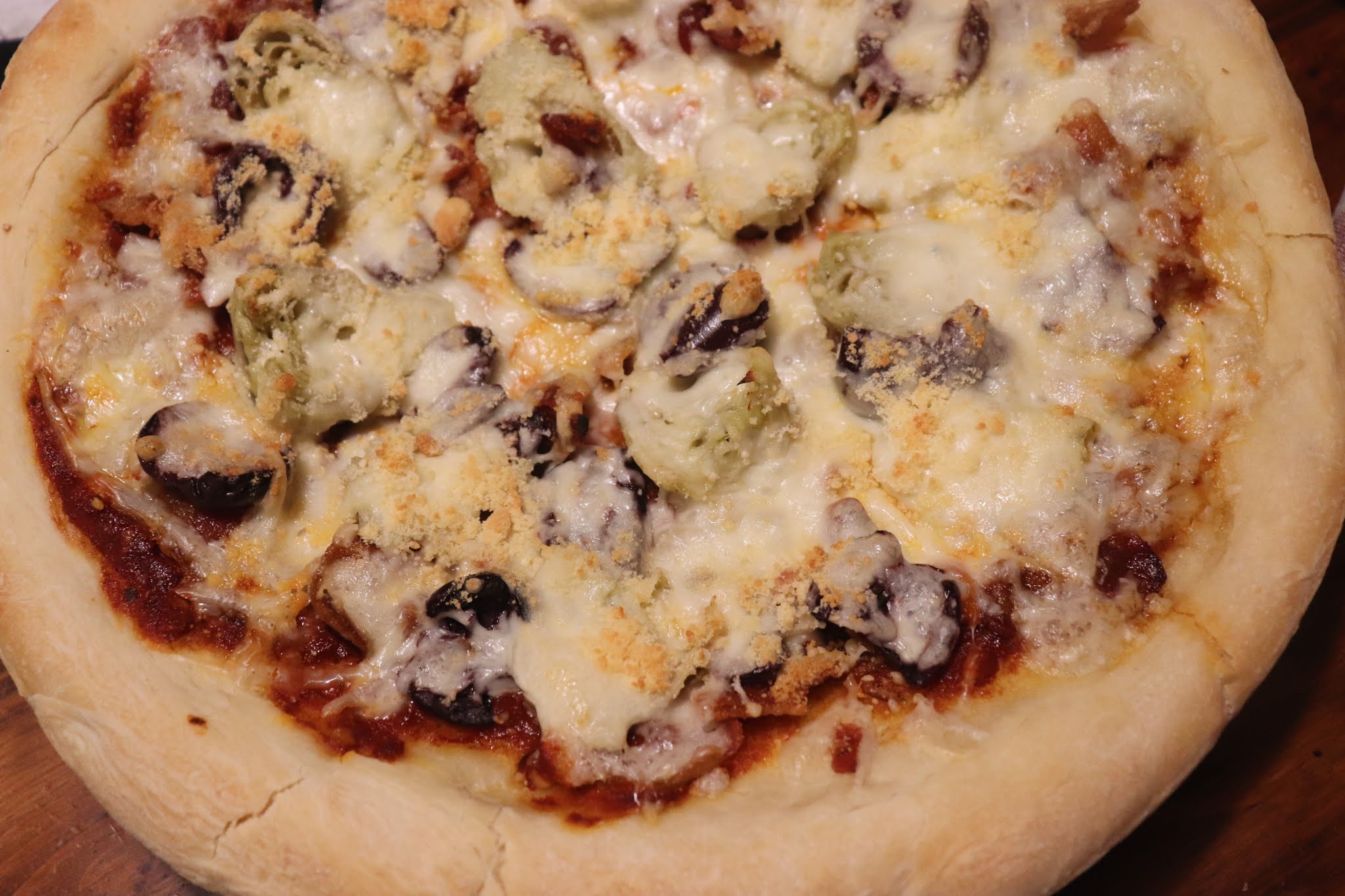
Whether freezing or serving the same day, you always want to partially prebake your pizza crust. That’s the first tip. This second time around I brushed the crust with olive oil before adding toppings, and that worked well, but whether you do that each time or not is up to you. You might want to try both ways and see which works better.


Secondly, add all toppings except cheese for about 2/3 of remaining baking time. Add cheese only for the last 3-5 minutes. This prevents a layer of melting cheese from sealing in moisture to make a soggy crust. 


Partially bake at this stage before adding cheeses


These two crucial tips will give you a satisfyingly crunchy crust, rather than a limp, bready carrier for toppings.


My toppings for pizza #1 from this latest dough session made for an okay but not exciting pizza. For pizza #2, I started once again with homemade sauce, and between sauce and cheese (grated mozzarella and Parmesan) came (as pictured in today's second photo) bacon, artichoke hearts, and kalamata olives. It was fantastic! 


Final fantastic result!


Friday, January 1, 2021

A Successful Year-End Experiment


Rather than saving the end result for the finale, I’m revealing it here right up front. This was my version of savory clafoutis featuring ham and leeks. 


The classic clafoutis comes from the Limousin region of France and features unpitted fresh black sweet cherries. I hadn’t realized there were so many variations, but then, it’s possible that Christophe Felder, the well-known French pâtissier, invented the many versions in his book, Clafoutis de Christophe. At any rate, the two major divisions are sweet clafoutis (sucrés) and savory (salés), the latter particularly intriguing to both human members of our household and a completely new idea to me.


With so many mouth-watering variations offered, it was hard to choose which to try first. I leaned toward ham and leeks, since we like both. I also liked the attractive bundles of slivered leeks wrapped in slices of ham but thought the ham was not quite in scale (it looked somewhat gross and heavy, even in the beautiful color photograph) and that prosciutto would be better – thin slices of meat, slender slivers of leak. But my quarantine kitchen partner vetoed prosciutto (“too fatty,” he says), so I compromised by cubing the ham and slicing the leeks into rounds, more in the style of the Clafoutis poireaux et lardons.


Using this cookbook presented multiple challenges. (1) To begin with, every word is in French, and there were words whose meaning I had to seek in a dictionary, e.g., chapelure. Would you have known that one? (2) Second necessity was that of converting metric measurements to American. Twenty-five centileters = 1 cup; 150 grams = 2/3 cup; etc. (3-4) Then there was oven temperature, which I had to convert from Celsius to Fahrenheit and adjust the Fahrenheit temperature for high altitude – and I cannot tell you how many times I calculated and checked and re-checked the oven temperature for my clafoutis until finally, after a careful search through many recipes in the book, I realized that the savory recipes required baking at about 100ºF higher than the sweet recipes. 


I guess there was a small fifth challenge, as French crème fraîche is not readily available in the U.S. While it is possible to make a substitute, using sour cream or buttermilk or yogurt, I was happy to find crema Mexicana locally, which fit the bill to a T. One cup of crema, one cup of milk (I used evaporated milk straight from the can), two whole eggs, and two egg yokes, beaten together with slightly less than 2-1/2 teaspoons (10 grams) cornstarch, and this, with the addition of salt and pepper, is poured over the ham and leaks in a baking dish that has been buttered and dusted with fine crumbs. The next time I try a savory clafoutis I’ll add grated Parmesan to the fine crumbs, because that crispy crust could only be improved by cheese flavor. 


Freshly grated nutmeg was my idea, and that was, if I may be so immodest as to say so, an addition of genius. 


After thirty to forty minutes in a hot oven (425ºF here in the mountains), the dish puffs beautifully. It has the lightness of a souffle and yet the smooth texture and richness of a baked custard – which is what made the nutmeg dusted on top even more appropriate than I imagined when the idea came to me.


Remember that fresh, uncooked, spicy cranberry-walnut relish from Christmas dinner? Cold and crisp, it was an ideal complement to the hot savory custardy main dish.


I feel so much like Julia Child (a rare feeling for me) in offering this recipe to you (well, it is actually Christophe Felder’s offering, not mine, but I, like Julia, have made it available to American cooks) that I can only close today by echoing Julia: “Bon appétit!”


Sunday, April 19, 2020

Quarantine Kitchen: Roaring Success with Sourdough Crust Pizza

My first-ever homemade sourdough starter has been active for a while now, and there’s no reason why it shouldn’t carry me through this stay-at-home time. As an added bonus (besides delicious baking smells filling the place where we shelter), frequent baking is a welcome relief from continuous national news. So on Saturday I resolved to make pizza.

For a pizza dough recipe, I used one offered online by King Arthur Flour. That recipe calls for a first rising time of four to six hours, and three hours worked just fine for me on Saturday. By then the dough had risen sufficiently and, when punched down, was so beautifully stretchy that my excitement leaped upward. Such a happy moment! But one I could not photograph, my hands busy with dough.


Here was the basic layout for putting together my pizza:


My sauce was homemade, beginning with tomato paste from a tube (love this stuff!) and adding water, salt, rosemary, and oregano. (Other herbs would have been possible, but these are the ones I had on hand.) I also roasted three large garlic cloves in their paper skins, in olive oil, in a small skillet. That trick I picked up from an old Julia Child TV show and will be using often from now on. You can see the beautiful golden garlic mashed on the little green plate in the photo above. And in the white bowl you see four meatballs. The last time I made meatballs, we had two meals from them, and these four went into the freezer. Thawed and crumbled, they provided a sausage substitute for the pizza. I also sliced part of a red onion very thin. Black olives were the final touch. 

Olive oil drizzled into the pan and spread by hand is all that's needed before the dough is spread in the pan, covered, and left to rest for about 15 minutes before toppings are added.


Now comes the big tip I picked up from that online recipe. Really, if you love pizza and love making it at home, this could change your life! Do not put the cheese on the pizza before you put it into the oven! 

Does that strike you as strange? Counter-intuitive? Heretical? Here’s how the online site explained it: If cheese is added immediately, it serves as a “lid” that holds in moisture from sauce and other ingredients, and that is what turns crust turns soggy instead of crusty! 

Baking time for the pizza will vary with the thickness of the crust – longer time for thick crust, shorter for thin – but this is not rocket science: you can peek into the oven and see how things are going. As a general rule, about 2/3 of the way through the baking process, pull the pizza out of the oven and add the cheese topping. (Another step I failed to photograph in my excitement – sorry!) Then, back into the oven for the remainder of the baking time.


Does that look beautiful? My first sourdough crust pizza could have used more sauce than I made for it, and I forgot the sliced fresh tomatoes I meant to add, but those minor criticisms were all mine. As for the opinion that really counts, I was told, “This is best pizza crust I’ve had in my life!” He told of his first Chicago pizza and how much he’d loved it -- but said my crust was better! Best ever! Now that’s what I called a roaring success!


P.S. I know we are spending a lot of time in our kitchens these days, as well as a lot of time in front of various screens, but I do hope I have company in my reading, too, and my current mission (as a bookseller far from her currently closed bookstore) is to read and review some of the new books coming out this season. Please take a look at my Books in Northport blog and learn about new books I'm showcasing there.

For now, happy cooking, happy baking, and happy reading! This pandemic won't last forever, and one day we will see each other again, face to face. Until then, stay safe!

Saturday, November 16, 2019

How I Made Them and What I'll Do Next Time

It started with a package of condensed (concentrated) mincemeat and an idea. I'd made the mincemeat cookies before from the recipe on the box, many times, but it occurred to me on Friday afternoon that the little mini-muffin tins I used for chocolate-cream cheese-peanut butter brownie bites would be perfect for turning out cookies in the form of mini-wintercakes for Lynne Rae Perkins's book signing of her latest children's book, Wintercake. How appropriate would that be? After all, the wintercakes in Lynne Rae's story are rich with dried fruits. I even went all out and sifted the flour, which is something I've only started doing very recently. It's actually kind of fun.


Here is the cookie dough, well mixed:


And then comes the moment to deploy the darling little muffin tins (even my husband, the Artist, thinks they're adorable) and the tiny fluted paper cupcake holders that will make the minicakes easy to remove from the pans, transport to the village, and serve in the bookstore. 


Baking the cookie dough even in tiny muffin tins means adjusting the baking time. As cookies on a sheet plan, they would spread out flat and be done through faster. This way, instead of 8-10 minutes, figure on 12-15 minutes in the oven. 

You wouldn't believe how good the house smells during the baking of these spicy little sweethearts, and the aroma lingers deliciously, temptingly, into the morning of the next day. What I'll do next time, though, is sprinkle maple sugar on the little cakes right when they come out of the oven. You could also sprinkle colored sugar, if you prefer, or wait until they cool and frost them. Lynne Rae Perkins is such a creative person -- writer, artist, baker, cook, craftsperson -- that anticipating her as my guest today I was inspired!


Wednesday, December 5, 2018

Kitchen Memories and a New Specialty From the Oven


Winter arrives, and the kitchen beckons. Holidays approach, upping the ante. Holidays increase both a slightly anxious pressure and the happy or bittersweet weight of memories. The other morning, the first text of the day from the younger of my two younger sisters was this: “It’s been three months, sisters.” Three months since our mother died, that is. That loss, still sharp, is now accompanied for us by all our family memories of holiday kitchen projects: cookies we helped make and decorate from the time we were little girls; our mother’s amazing marzipan; her special coffee cakes; those intricate, magical sugar cube houses that sat on the sideboard, nested in a bed of cotton “snow” and surrounded by candles in the shape of pine trees; her inimitable peanut brittle; and so much more. I get out her old, old cookbook and turn the pages, where the most meaningful recipes to me are not those cut from magazines and taped in but the ones she copied out in here own hand. Handwriting on paper! How could anything “digital” hold so much of a person’s essence?


My only actual baking this year, however, came from a recipe on the inside of a box as, for only the second time, I set out to make peanut butter cheesecake brownies. On the first trial, a few months back, I had baked the brownies in muffin tins and was happy enough with the results that I wanted to experiment further in that direction. Hence the mini-muffin tins, with individual cups the perfect size to duplicate bite-sized cheesecake brownie treats (well, more like three bites each) that I’d discovered in a grocery store bakery in the Southwest.

(Measuring spoons for scale)
The recipe on the box was clearly written for people in a hurry, because it told me to melt the chocolate and butter in a microwave oven. Call me old-fashioned (you won’t be the first), but I prefer to use a double boiler, especially with the other changes I was making to the process. While chocolate and butter were melting, you see, I had time to grease my muffin tins. Of course, the recipe people had not foreseen the use of muffin tins so cannot be faulted, I suppose, for trying to rush the process. 


*** Excuse me, though, because here I have a thought that is a complete digression from memories and brownies but important enough that I want to interrupt myself to get it in. All these “quick” recipes that call for “instant” mashed potatoes and “instant” oatmeal? Please, please, please don’t do that! You might as well just sit down and eat a bowl of sugar! You think “it’s good for them in a casserole or a cookie”? No, not that pre-digested stuff: it leaves your digestive system nothing to do and does nothing for you but prime your system for more sugar. End of lecture. ***

Baker’s Chocolate instructions were at first somewhat confusing to me when it came to the eggs. They called for five eggs, “divided.” I never heard of “divided” eggs. Did they mean separated? Well, clearly not, because further along the eggs, not egg yolks and egg whites, were to be added — but not all at once to the same bowl. What the recipe had intended to forecast was that four eggs would be added to the chocolate mixture and one to the cream cheese and peanut butter mixture. Okay, that's settled!


Then there was the matter of swirling the peanut butter and cream cheese and sugar mixture (2-1/2 cups of sugar were also “divided,” 2 cups going into the chocolate/butter mix and 1/2 cup into peanut butter and cream cheese) into the chocolate mixture that also had flour added last. In a pan, swirling can be done with a knife, but in the tiny muffin tins only a toothpick would do the job. 


Do they look messy in the pans? I had moments of doubt at this stage.


Time in the oven for the different variations had to be adjusted by guess and by gosh, since brownies in the large muffin tin did not need to bake as long as those in a traditional cake pan, and those in the mini-muffin tins baked fastest of all. A watchful eye, initial short baking period, and an additional five minutes here and there seemed the recipe for success. It would depend on your ovens and your pans. 

In the end, all variations produced acceptable results, and though my mother never used this basic recipe, as far as I can recall, I could easily imagine her sitting at the table nearby, following the entire procedure, getting up to examine the brownies as they came out of the oven, and eventually giving them the taste test and pronouncing them “Very good, sweetheart!” 

My sisters and I returned to our morning text-fest, remembering a year when our grandmother was with us for the holidays and we had an old-fashioned taffy pull in my mother’s little kitchen. Small, that is, but not as small as the one I call my “Paris” kitchen. Still, my mother’s kitchen was probably good training for not letting lack of space get in the way of cooking and baking. 


My mother and grandmother are with me still when baking season comes around, as they are with my sisters, and we are fortunate to have memories to share.