Search This Blog

Showing posts with label cookbooks. Show all posts

Tuesday, April 6, 2021

Madeleines: Who Says They’re “Tricky”?

The pan, or mold, is essential.


The essential baking pan with its shell-shaped creusees traveled with me from Michigan to Arizona in November, so there was no reason my first attempt had to wait until April. Was I intimidated because by the reputation of these iconic French dainties, famous not only for their origin but legendary for the literary role played by a madeleine dipped in tea by the narrator of Proust’s Remembrance of Things Past, the taste of which brings back a rushing flood of childhood memories?


Not exactly a cookie, and not anything I would call a pastry, either, the darling little tea cake’s richness is belied by the simplicity of the ingredients. At least one online recipe source, however, referred to the making of madeleines as “tricky.” Luckily, I was spared that added anxiety, as I did not look online at recipes until after having done the deed – and only then to provide a link on Facebook for friends unfamiliar with the madeleine. My own preparatory research was faster and more direct: Prosper Montagne’s Larousse Gastronomique: The Encyclopedia of Food, Wine and Cookery


More than a cookbook, Larousse Gastronomique provides history of various foods and food-related items, all arranged in alphabetical order. Was the inventor of the madeleine Prince Tallyrand’s pastry-cook, or were they known earlier, first made in the town of Commercy? Certain it is that Commercy long guarded its “secret recipe” for madeleines, the specialty that put the town on the map of France, and Montagne gives two recipes, that for a madeleine de Commercy and another for a madeleine ordinaire. You might say I used both, because what I did was to cut in half the proportions given for the ordinary madeleine and add the lemon zest from the Commercy version.


Recipe:


And so, to ½ cup of sugar, 1 cup of sifted flour, a pinch of salt, two eggs, and ½ teaspoon of vanilla (amount not specified, but that’s what I used) I added ½ cup melted butter and the zest of one lemon. (Use your own judgment, but I let the butter cool slightly rather than pour it directly into the flour and egg mixture as soon as it was melted, not wanting to have a bowl of floury scrambled eggs on my hands.) Tip: If you find yourself in someone else’s kitchen and don’t have a flour sifter, spoon the flour into a fine-mesh strainer and jiggle it through by hand. It works just fine.


substitute sifter

smooth batter

before...


The resulting smooth batter is then spooned into buttered and floured molds and popped into the oven at 375 degrees for 15-20 minutes. I let them cool before popping them out of the pan. Perfect!


Variations:


Powdered sugar can be sieved over the warm tea cakes before serving, but I chose not to gild the lilies this time around. I may do so another time. And here’s a possibility from the baker who warned of potential failure: Carefully bring the butter past simply melted all the way to browned, and your finished tea cakes will be darker in color and perhaps with a somewhat nutty flavor. Try it and let me know. You do have to watch the butter every second to ensure it does not go past browned to burnt.


Actually, what I have in mind to try sometime is orange instead of lemon zest and a small amount of dark chocolate (!) melted with the butter. Does that sound like heresy? What would Proust say? It would certainly not be a classic madeleine, but something tells me it might be delicious. The "ordinary" ones certainly are. 


P.S. We all have our "madeleine moments." Here's one I wrote about on an earlier occasion.


P.P.S. Here is the subsequent chocolate story.

Monday, February 22, 2021

Why Bother With Cookbooks?

Not a pepper, after all! See postscript.

 Some people don’t. Don't bother with cookbooks, that is. Isn’t everything on the Internet, and aren’t all the recipes your heart could ever desire a couple taps away on your phone?


No, not everything is online -- someone had to upload it, or it isn’t there – but yes, there is probably more at your fingertips than you’ll ever look at, let alone use, which brings us back to my original question, and if you’ve already decided to “bother” with cookbooks no longer, I’m probably not going to convince you otherwise. Don’t they take up precious space that could better be used for cookware? Aren’t they really just – clutter? Since I grew up in a family of readers (as well as a family of letter-writers, but that’s another story), as long as I live I will never see books as clutter. 


(When in my early teens I baby-sat for neighbors, the most challenging job was in a house that contained no books. Not a one. There was a TV Guide and a Victoria’s Secret catalog. That was it. On that job, I occasionally did homework but basically watched a lot of television, clear through to the channel sign-off signal -- something that no longer exists. But the young couple, parents of a madcap little Dennis the Menace, stayed out late and they paid well.)


So what I’m getting at, in my usual roundabout way, is that cookbooks for me are books first, recipe collections second. I like it best when they either have photographs or give me paragraphs – preferably pages! – of thoughtful prose, and if the author offers me both, that is a dream book. 


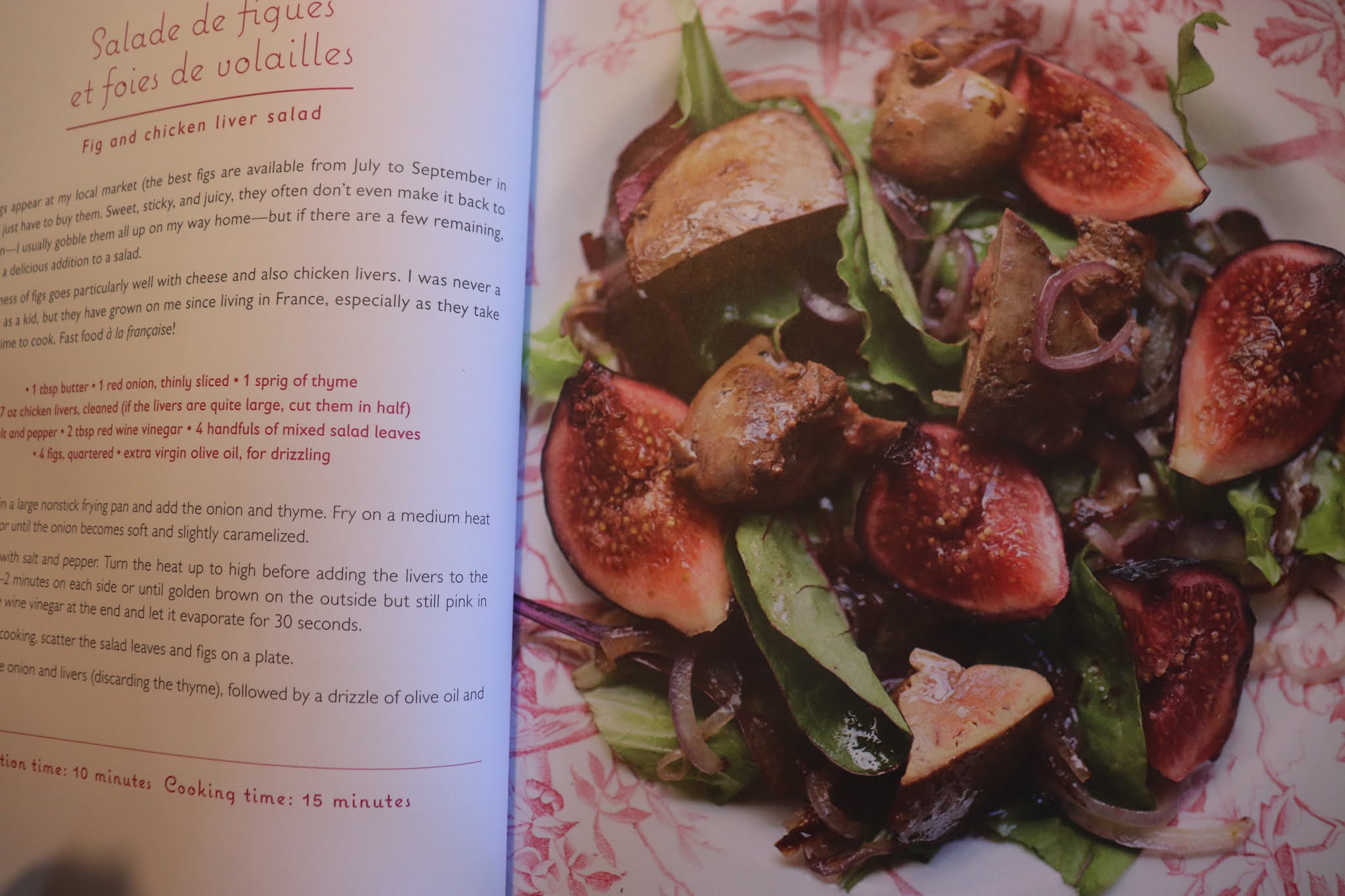
The first recipe in Rachel Khoo’s The Little Paris Kitchen (and how could I possibly resist a book with that title? I ask you!) is for a salad of fresh figs and chicken livers. Rather than diving directly into instruction or a list of ingredients, Rachel muses as follows: 


When figs appear at my local market (the best figs are available from July to September in France), I just have to buy them. Sweet, sticky, and juicy, they often don’t even make it back to my kitchen – I usually gobble them all up on my way home – but if there are a few remaining, they make a delicious addition to a salad. - Rachel Khoo


Oh, be still, my heart! Fresh figs! Growing up in the Midwest, I knew only dried figs and the cookies known as fig bars. When our hostess in the Ardèche offered me a fresh fig right off her tree and I bit into it, I burst into tears! Looking at the photograph of Khoo’s salad, I taste the sweetness and feel the graininess of the seeds in the fruit pulp, and I would give anything for a fresh fig!


Alice Waters, besides being the sister of a good friend, inspires me. Alice does not preach precision. She gives a basic idea and then encourages her cookbook readers to make substitutions and try variations. She writes: 


Flexibility is an essential component of good cooking. You should never feel locked in to a recipe or a menu unless it involves a basic principle regarding procedure or technique such as those involved in breadmaking and pastry. I don’t ever want to write anything in this book that is so precise that the reader must invoke great powers of concentration on every last detail…. 


…When you are faced with the absence of a certain ingredient, don’t panic; formulate your own acceptable or inspired replacement….

- Alice Waters


Isn’t that dear of her? To give us hope that our substitutions may be “inspired”? Oh, thank you, thank you, Alice!


It's always good to have one or two basic cookbooks on hand, and the basic cookbook I have here in Arizona is Irma Rombauer’s Joy of Cooking. (Back in Michigan I have three or four different basic books, one of them a reprint of the one I grew up using in my mother’s kitchen.) It seems I’m always looking up proportions for simple things like noodles or muffins or a conversion chart for measurements. Things like that. 


I must say, however, that Joy let me down recently when Rombauer wrote (and I believed) that “stone-cold” pans could be used for popovers. Not true! I have a whole story to share about popover failure, but that must wait for another day….


Here in our winter ghost town, I have only one shelf for cookbooks, not a whole bookcase as I have back in Michigan, so there are days when an addition to the shelf prompts me to consider de-acquisition of something else. Tough choices! 


In the Southwest, a Mexican cookbook is a must, isn’t it? So I was happy to add this one to my shelf. But will it surprise you when I say that Rick Bayless’s Mexican Kitchen: Capturing the Vibrant Flavors of a World-Class Cuisine is more intimidating to me than any of my French cookbooks? Basically, it’s the peppers. There are so many of them, and their names change when they are dried (as grape becomes raisin, poblano becomes ancho), and the true Mexican cook is not only a master of capsicum but of so much more!


The other day, though, at last I roasted a pepper over a gas flame on the stove, something I’ve been intending to try for years and finally got my courage up to attempt. Blistered the skin, let the pepper cool, scraped off the skin, scraped out the seeds, and chopped up that pepper to add to chopped fresh tomato, white tomato, onion (Mexican cooks prefer the white, I learned from Bayless), and garlic. The pepper I roasted (what was its name???) was not particularly hot, so I did add a few drops of hot sauce. And my salsa was good! So I made a start, at least. Baby steps….


Then, last year I found and bought a German clay cooker, and this year I found the cookbook to go with it! Serendipity! That should help me get back to experimenting with “ancient pot” cooking, because my clay cooker has been feeling rather neglected, I know. A whole book, not just one online recipe at a time.


And just on the heels of a gout attack in our household (I was not the victim), which led me to think we should eat less red meat and more chicken, a visit to the FOL bookstore over in Pearce/Sunsites turned up this book: 


What could be more timely or more inspiring? I am excited already, having only looked through a dozen pages! 


Inspiration. Encouragement. Memories. Pleasure. That’s what I find in cookbooks. I can’t imagine my life without them.


IMPORTANT POSTSCRIPT! My sister reminds me that the catalog at the bookless household was Frederick’s of Hollywood. Victoria’s Secret did not yet exist. (That shows our age, doesn't it?) Then, a very savvy foodie friend set me straight about chiles and peppers: they are not the same genus! See an explanation here


So much to learn — at least I had that right!


Saturday, November 11, 2017

Memory's Lasting Perfume


When snow arrived this week, I brought my rosemary plants into the house. Rosemary is a tender herb, native to hot, dry climates like Provence, and will not survive a winter outdoors, so one of my Friday projects was to strip the fragrant leaves from the longest stems for winter drying. Because the resident Artist, in his home office, has the only south-facing window in ou4 old farmhouse, that is where the remaining trimmed plants are resting for the time being.

My friend Helene referred to her dining room windowsill of plants, fresh herbs and a few pots of blooms, as her garden, and early on during my stay with her we established our mutual love of growing things. Years later (and years into our transatlantic correspondence), when I came to live here in the farmhouse, I would sometimes sit out by my vegetable garden at sunrise and write a description of the scene to my faraway friend, who was kind enough to praise my laborious essays — truly, attempts — in French. 


At last one year I received no answer to my last letter for a worrisome length of time and got a disturbing recording when I called her phone number. I telephoned her downstairs neighbor, heart pounding. Yes, Helene had died. She was then, after all, 90 years old by that time and had had health issues for all the years I’d known her, but the shock was no less painful for being unsurprising. And Mme. Lamy could not help telling me, over and over, that Helene had “suffered terribly.” Each time she said it, I recoiled from the painful stab of that awful phrase. But Mme. Lamy also told me, several times, how happy Helene had always been when the mail brought a letter from me, and I take comfort still in knowing I gave her some little bit of joy now and then. 


Rosemary is good for flavoring vegetables and meats, especially suckling pig, veal, lamb and game. It keeps its pungency well when dried. Use this herb with moderation, as it has a very strong aroma and flavor. - Ginette Mathiot, in I Know How to Cook

Never in my life have I prepared suckling pig or veal, but I do love lamb, and there is no cooking or even living without vegetables. 

The New Putting Food By (not that “new,” actually, as my third edition has a 1982 printing date) cautions that rosemary must not be dried at higher than room temperature and dries best away from light. Just as well. Moving the rosemary-drying operation upstairs means not adding one more project to our crowded downstairs living space, where my apple-drying project continues in full swing evening after evening. 


Rosemary is one of the flavors (un des parfums) in the beloved French mixture called “herbes de Provence,” which sometimes includes lavender, too, along with other herbs. It was in Paris that I came to know and love and require herbes de Provence in my cooking on a regular basis, and so for that reason, along with my memory of my friend’s windowsill garden, Helene is very present to me as I handle these sharply fragrant leaves.


Is there someone in your life whose day would be brightened by a letter from you?


Her letters brought joy to me, too


Monday, January 11, 2016

Des Fruits et des Légumes en Hiver (Of Oranges and Green Beans)

On the rue des Martyrs, Paris, France


Well, we are not in Paris, France, but still here in northern Michigan, and we have now entered the long, glistening white tunnel of winter. We will be in the tunnel for many weeks to come, barring another stretch of unseasonably warm weather, so on a cold, wild Sunday of blowing and drifting snow it’s a great comfort to have the luxury of staying snugly home, with pot after pot of hot tea and fresh-cut sections of juicy oranges. I tell David we must eat citrus fruit while we can, since depredations of alien insects in the Florida and California groves, not only spoiling crops but actually killing trees, may put the price of oranges and grapefruit and lemons beyond our reach before too long. I hope not. Anyway, for now we have oranges in winter -- oranges in the snow, as it were. A princely delight!

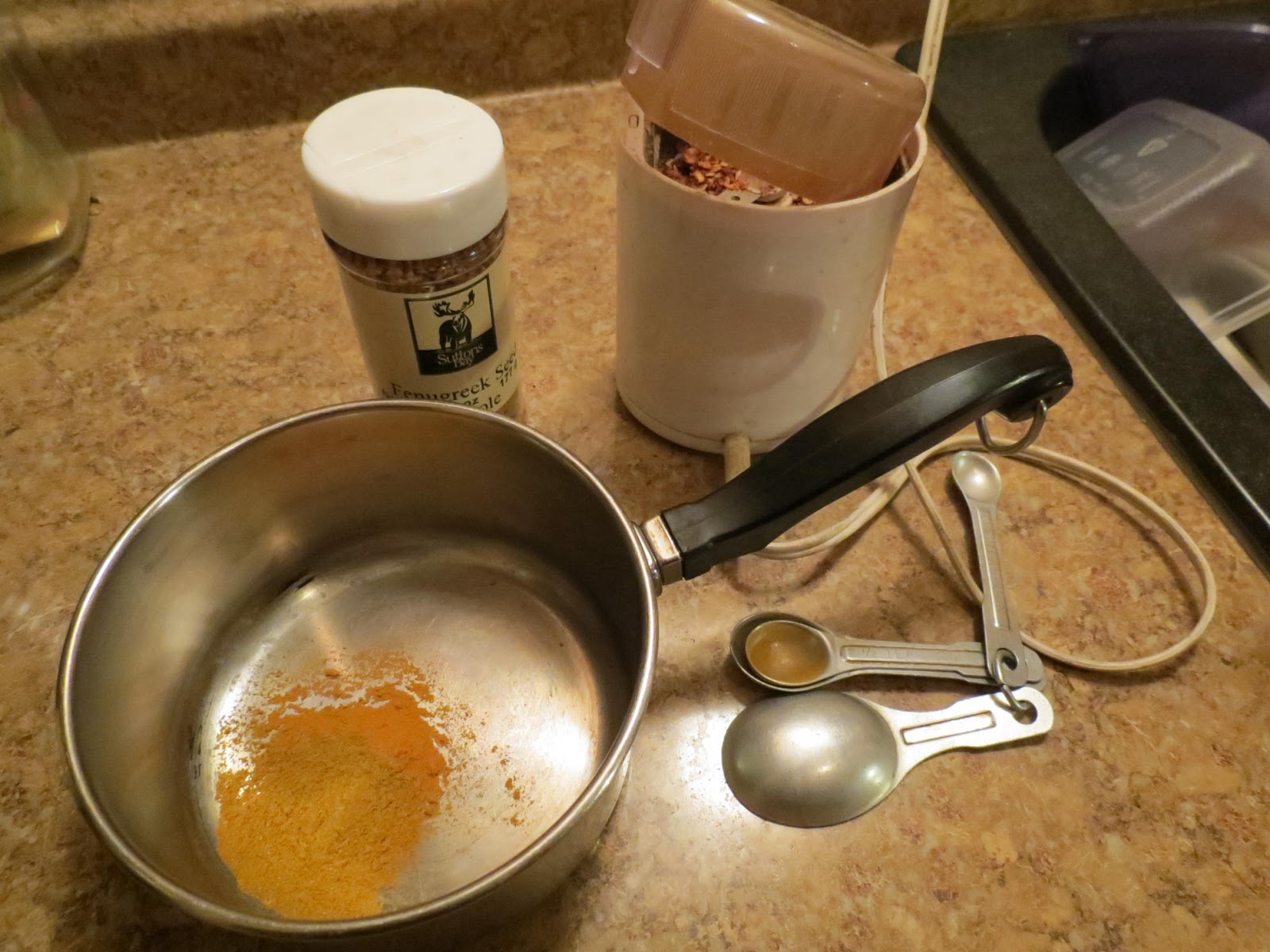
On a cozy day at home in winter my food thoughts yearn toward the foods of Africa. Quite honestly, though? I’d prepared well in advance for today’s kitchen adventure. For one thing, I had to make a trip to the specialty spice shop in Suttons Bay for fenugreek seed, and then it took several visits to the grocery store before Tom’s Market had green beans nice enough to satisfy me.


Here is the inspiring cookbook: The Africa News Cookbook: African Cooking for Western Kitchens, published by Penguin in 1985. The recipe that caught my eye over a week ago is called green bean atjar, or green bean pickles, but these are not at all like pickles my mother and grandmother made. No vinegar. They are, rather, spiced green beans, packed in oil and refrigerated before serving. According to the book, they will last up to a month in the refrigerator without processing, and so I imagine my beans as one dish in an African dinner sometime in the near future.

Two notes from my kitchen: 
(1) You might think I would want to make this dish in summer with fresh beans from garden or farm market. But why sacrifice the freshness of summer vegetables to oil and spices? No, to my mind this is a perfect winter dish. 
(2) The recipe does not specify what kind of oil to use. I decided on peanut oil, because it is used all over Africa and, also, the oil in this recipe is brought to a boil – not a happy fate for olive oil, I’m sure you’ll agree.

Here is an odd kitchen tool. I have no idea what it is called or where this one came from, but I use it all the time. It is so much easier than a pot lid when water is to be drained off vegetables and quite handy on occasions when a big colander would be overkill.


Sometimes, of necessity, kitchen activities expand beyond the confines of the tiny kitchen. This is another reason for making certain dishes ahead and not trying to do everything on the evening a dinner is to be served. The dining table, tablecloth whisked away, becomes a staging area, especially important as Sunday is bread day, too.


The proof of my South African spiced green beans will be in the eating, a story for some future post. Meanwhile, “Bundle up, campers! It’s cold out there!” Now who recognizes that movie quote?


Saturday, January 2, 2016

A New Year 1, 2, 3


A small kitchen is necessarily kept simple. There is no room for a dishwasher, for instance, and nowhere to stack all the bowls and utensils for one big wash-up later on. Instead the cook is motivated to keep dishes washed up, a few at a time, by hand, during the food preparation and cooking process. Washing dishes by hand can be meditative. For me it’s often time to begin planning out a blog post, writing and rewriting in my head before sitting down to look at words in sentences.


Limited counter and storage space keep electric appliances to a minimum. Having dishcloths, towels, spices, and utensils close at hand is a higher priority, and often, from years of simple habits, I reach automatically for a hand whisk rather than hunt up the electric mixer.

But there is no substitute for a waffle iron.

My mother, my earliest teacher of kitchen wisdom, knows this well, and it was she who gave me my waffle iron. Most of the time, it’s hidden away in the back of a cupboard, but a couple times a year, on special occasions, out it comes, and New Year’s Day morning was one of those special occasions. A holiday, of course, meant a relaxed morning at home, but besides that, I’d fallen behind in my bread baking over a stretch of unusual holiday scheduling at the bookstore. No eggs without toast for David! But he loves waffles.

For some home cooks, simplicity means mixes and frozen entrees. For me it usually means cooking slowly, from scratch, with fresh and organic ingredients, but I have to admit that on New Year’s Day I had a box of pancake mix in my cupboard -- pancake mix, not pancake and waffle mix, though. So out came my oldest and most trusted cookbook, because I was going to be improvising and needed to check several recipes, both for pancakes and for waffles, to see what I would need to add to the mix. And if not for that need to improvise, I would never be writing about my New Year’s Day waffles at all. From a mix? Please!


The most basic difference between pancakes and waffles is that the eggs are separated in the making of waffles, the egg whites beaten stiff and gently folded into the other ingredients at the very end. A bit of shortening is also called for in waffle batter. So I melted a couple tablespoons of butter and separated three eggs (I was flying by the seat of my pants, but two just didn’t feel like enough), and also substituted whole milk for the water called for on the pancake mix box. It all seemed reasonable, but would it work?

The moment of truth is opening the waffle iron to take out the first waffle. It is an anxious moment! Will the hoped-for waffle stick to the iron? Will it tear apart? Or will it retain its integrity but be disappointing in texture or taste?


Practically perfect! The kitchen new year is off to a good start!

Number 2 kitchen project of the day was hoppin’ john. Good ham, chopped finely, cooked up with chopped onions. (How can any dish fail when it begins with an onion?) Chicken broth from the freezer. White and wild rice. Organic (yes, canned) black-eyed peas from a company right here in Leelanau Township.


Black-eyed peas always make me think of my mother’s stepfather, who grew up in northern Florida. Wild rice carries my mind up to the Upper Peninsula, the birthplace also of the maple syrup on the morning’s waffles, gift of a writer friend. And of course I’d already been thinking of my mother, who gave me the waffle iron. So you can see, what with all those memories, it was pretty crowded in my tiny kitchen on New Year’s morning. Fragrant, too.


We were invited to a neighborhood party in the late afternoon, inspiring me to undertake NYD kitchen project #3, sour cream pumpkin cake, made entirely from scratch, with no canned ingredients or mixes. I had frozen the excess cooked, mashed pumpkin from my Thanksgiving Day pie and had everything else in the refrigerator or cupboards.

I rarely bake cakes. Pies, yes. Cakes, seldom. Consequently, every cake project is a learning experience for me, and one lesson I learned the last time around was that mixing cake batter by hand with a whisk or wooden spoon is more than I can successfully manage. My arm would fall out of its socket before the batter achieved desired smoothness, the necessary prelude to a light finished cake. 

Out came that electric hand mixer, after all. Oh, my god, the roar! I felt as if I were standing on a helicopter pad, in a war zone, surrounded by menacing airborne machines! The front of the mixer even looks menacing, doesn’t it? 


But the batter grew smoother by the minute.


I love the moment, not captured here on camera, where cake batter is poured into a pan, falling from bowl to pan in a series of graceful folds. That is a moment of grace, full of promise. And then the pan goes into the oven. A twist of the timer. (Simple, in the Paris kitchen!) [photo of timer] And gradually a spicy aroma emanates from the tiny kitchen and fills the old farmhouse. Waiting, writing....

The toothpick (test for doneness) comes out clean. The cake smells delicious. It looks a bit pale and plain, but I don’t feel like making streusel topping. Perhaps a dusting of brown sugar? Or cinnamon sugar? Let is cool and sift on powdered sugar? How about sifted powder sugar and cinnamon. I think I’ll go that last route.


Well, it’s been a good morning in the kitchen. Now it’s early afternoon and time for tea.


Postscript: Was that cake not strangely pale? Oddly flat? When it was cut into at the party (luckily, I had also taken my hoppin’ john), the peculiar texture was not at all what I’d hoped or expected. People liked it anyway, most for being “not too sweet.” But what went wrong? Baking powder too old? Around 5 a.m. the answer came to me. I remembered photographs, in that oldest of my cookbooks, of popovers at different oven temperatures. I must have bumped into the dial on one of my passes through the doorway. Oven temperature too low would give exactly the result I got.


Which goes to show that no kitchen is so small that it will not yield failures as well as successes. In that the kitchen is a microcosm of life. And in the kitchen, as in life beyond it, failure usually has something to teach. Good reminder for the first day of a new year, which will no doubt bring new challenges on many fronts.