Search This Blog

Showing posts with label French cooking. Show all posts

Tuesday, April 6, 2021

Madeleines: Who Says They’re “Tricky”?

The pan, or mold, is essential.


The essential baking pan with its shell-shaped creusees traveled with me from Michigan to Arizona in November, so there was no reason my first attempt had to wait until April. Was I intimidated because by the reputation of these iconic French dainties, famous not only for their origin but legendary for the literary role played by a madeleine dipped in tea by the narrator of Proust’s Remembrance of Things Past, the taste of which brings back a rushing flood of childhood memories?


Not exactly a cookie, and not anything I would call a pastry, either, the darling little tea cake’s richness is belied by the simplicity of the ingredients. At least one online recipe source, however, referred to the making of madeleines as “tricky.” Luckily, I was spared that added anxiety, as I did not look online at recipes until after having done the deed – and only then to provide a link on Facebook for friends unfamiliar with the madeleine. My own preparatory research was faster and more direct: Prosper Montagne’s Larousse Gastronomique: The Encyclopedia of Food, Wine and Cookery


More than a cookbook, Larousse Gastronomique provides history of various foods and food-related items, all arranged in alphabetical order. Was the inventor of the madeleine Prince Tallyrand’s pastry-cook, or were they known earlier, first made in the town of Commercy? Certain it is that Commercy long guarded its “secret recipe” for madeleines, the specialty that put the town on the map of France, and Montagne gives two recipes, that for a madeleine de Commercy and another for a madeleine ordinaire. You might say I used both, because what I did was to cut in half the proportions given for the ordinary madeleine and add the lemon zest from the Commercy version.


Recipe:


And so, to ½ cup of sugar, 1 cup of sifted flour, a pinch of salt, two eggs, and ½ teaspoon of vanilla (amount not specified, but that’s what I used) I added ½ cup melted butter and the zest of one lemon. (Use your own judgment, but I let the butter cool slightly rather than pour it directly into the flour and egg mixture as soon as it was melted, not wanting to have a bowl of floury scrambled eggs on my hands.) Tip: If you find yourself in someone else’s kitchen and don’t have a flour sifter, spoon the flour into a fine-mesh strainer and jiggle it through by hand. It works just fine.


substitute sifter

smooth batter

before...


The resulting smooth batter is then spooned into buttered and floured molds and popped into the oven at 375 degrees for 15-20 minutes. I let them cool before popping them out of the pan. Perfect!


Variations:


Powdered sugar can be sieved over the warm tea cakes before serving, but I chose not to gild the lilies this time around. I may do so another time. And here’s a possibility from the baker who warned of potential failure: Carefully bring the butter past simply melted all the way to browned, and your finished tea cakes will be darker in color and perhaps with a somewhat nutty flavor. Try it and let me know. You do have to watch the butter every second to ensure it does not go past browned to burnt.


Actually, what I have in mind to try sometime is orange instead of lemon zest and a small amount of dark chocolate (!) melted with the butter. Does that sound like heresy? What would Proust say? It would certainly not be a classic madeleine, but something tells me it might be delicious. The "ordinary" ones certainly are. 


P.S. We all have our "madeleine moments." Here's one I wrote about on an earlier occasion.


P.P.S. Here is the subsequent chocolate story.

Sunday, July 17, 2016

How to Scramble an Egg (or Two)


Blank, eggy stare

I owe today's hot tip not to my French cookbook but to my sister Deborah. We were having breakfast at a local restaurant, and I asked her how it was that restaurant scrambled eggs come out so soft and creamy, so unlike mine at home. She told me the eggs are only briefly and gently beaten, so that not a lot of air is incorporated. That made sense, so I decided to try it myself. I had inadvertently left my camera at the bookstore overnight so couldn’t document the attempt, but here’s my story, anyway, and I’m sticking to it.

(1)        I chose a small pan and limited the trial to two eggs.
(2)        Before-pan scrambling – in a bowl – was accomplished with a fork.
(3)        When butter in the pan was melted, I turned down the heat and slid the eggs in.
(4)        I did not stir but watched the edges and gently folded the eggs over from outside to center when it was obvious that the edges were cooking.
(5)        Watching and folding were repeated until the eggs were no longer runny.

The result was pronounced, by He-Who-Adores-Being-Served, “Perfect eggs!”

A few days later (I kept forgetting), I looked in my French cookbook, fully prepared not to be surprised if there were no directions in there at all for scrambling eggs. The morning meal in Paris is generally café au lait and croissant, and I’ve seen French men and women add cigarettes to the classic Continental breakfast, never did I see anyone in France starting the day with eggs. When eggs are cooked in a French kitchen, they are generally baked or poached or hard-cooked or incorporated into a quiche, but none of these methods is applied to the breakfast table.

Surprise! I Know How to Cook, the English translation of Je sais cuisiner, does present a recipe for scrambled eggs. Sadly, however, I cannot recommend it. I don’t object to the addition of milk (and maybe I added a smidgen of milk to my eggs before they went in the pan; truly, I do not remember), but beating butter into them seems entirely unnecessary, and “stirring constantly for 12 minutes” sounds like terrible advice. Twelve minutes would cook eggs to death!

French cuisine holds pride of place in the world of cooking, but there are some things Americans do better: fresh, green spring asparagus are immeasurable more delicious than the fat, anemic white Continental objects, and while the French know sorbet, no one can argue that sorbet takes the place of real, creamy ice cream. Scrambled eggs? Faites vos oeufs, comme je les ai fait moi, à l’américaine.

Recreated for illustration


Friday, April 29, 2016

A Friend's First Trip

My friend Ed is going to France for the first time in June, not only seeing the sights but also studying French and taking a cooking class. You'll be able to follow his adventures here. I certainly plan to tag along via his blog.

Wednesday, September 23, 2015

A View Into the Kitchen, a Breakfast Casserole, and a Company Dessert


The kitchen in our old farmhouse is very small. In the photograph above, you are looking through the doorway (there's no room for a door) into the kitchen. Three or four steps, depending on the length of your stride, would take you from the sill to the back wall, and from side to side, there's no need to take steps -- just turn from sink to stove. Because it is so small, I call it my Paris kitchen, and I've written on my main blog, Books in Northport, about how I started calling it that.


There's no dishwasher in my (Up North Michigan) Paris kitchen and no window to look through during my dishwashing meditations. When I'm outdoors, I'm outdoors. When I'm washing dishes, I'm washing dishes. Or looking up at pictures of different breeds of chickens and dreaming of having live ones outdoors....

Despite the modest size of the kitchen, I finally treated myself to new appliances in 2015. Our brand-new refrigerator has a separate door for the freezer! The brand-new stove has a working oven! My new kitchen appliances are larger and more modern than the ones Julia Child had in Paris, and I'm no Julia Child, so they are all I need for the rest of my life.

The package on the counter above -- can you see it? -- is organic bacon from "the meat lady" at our summer farmers market. Below is the same bacon sizzling in a pan, and beneath that is the breakfast casserole I put together on Sunday morning for my visiting mother and sisters. 


Sadly, I completely forgot to photograph the casserole when it came out of the oven. Sorry!

David often asks me, when I bring dinner to the table, "Did you take a picture of that?" and I wave away the suggestion. During my family's recent visit, however, following a recipe from Jayne Robinson's The Cake Chronicles, I thought photographing my attempt at different stages might not be a bad idea -- and, in fact, I had done so last year, when making another recipe from the book, and when I became convinced that I needed an electric mixer: my fresh tomato cake last year, batter beaten by hand, while delicious, was just not as light as a cake should be. 

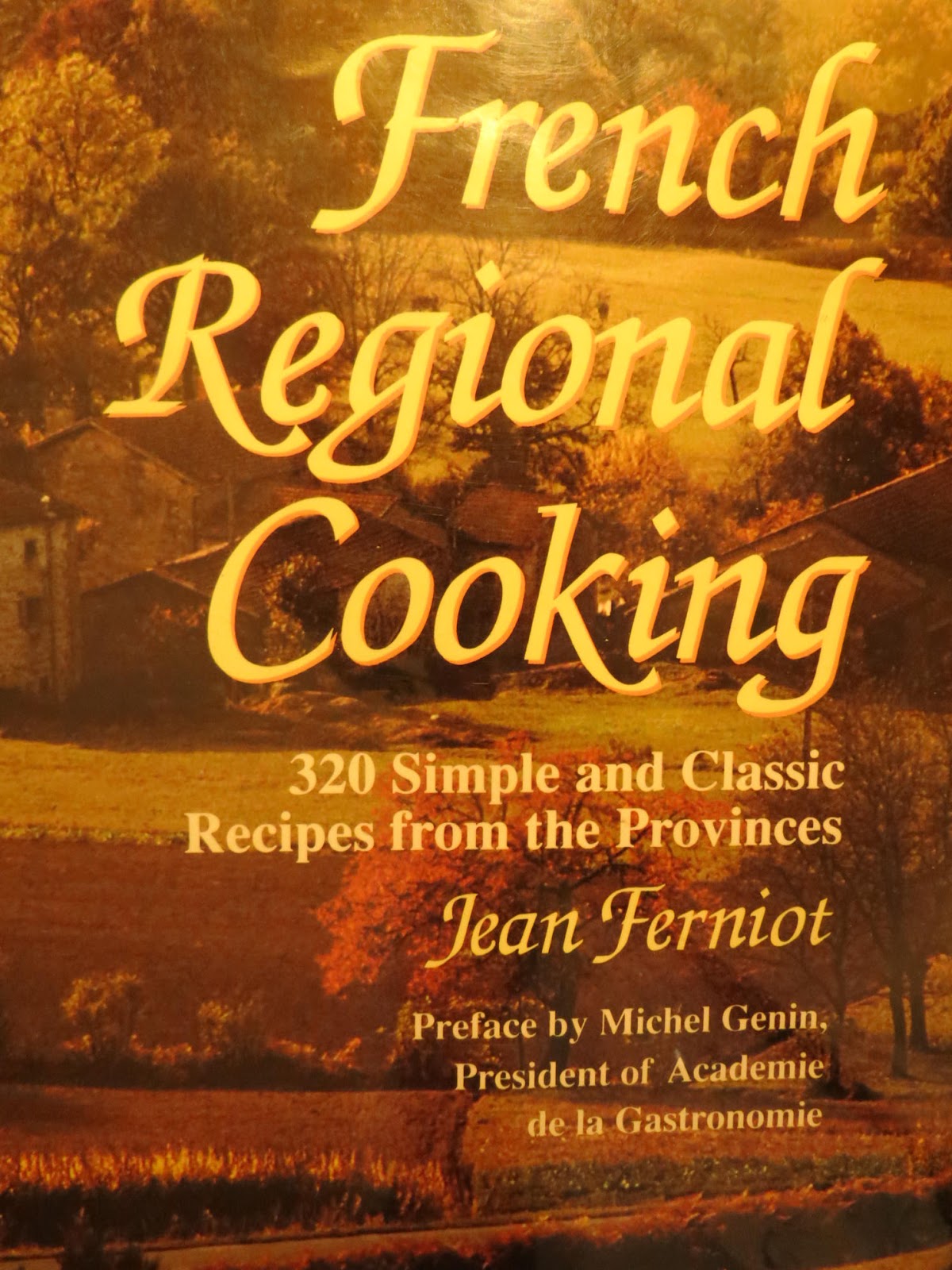
For this year's family reunion dessert, I decided to make what Jayne Robinson calls a Michigan sour cherry pudding cake. My mother and sisters and I agreed that we would call it a Michigan sour cherry custard cake, as the milk and cream and eggs deliver a texture and flavor more like custard than either pudding or cake. French Regional Cooking, by Jean Ferniot, another book I consulted, gives the alternate English/American name as cherry flan. The cherries I used were organic Balatons, and I pitted them hastily before freezing, racing the fruit flies, which explains the appearance of the dessert, both in process and in finished form.

Tart cherries distributed over half the batter in pie pan

Remaining batter poured gently over

Finished dessert, out of the oven

My cookbook of French regional recipes calls this by its traditional French name, clafoutis. It's a specialty of the Massif Central region of France, where I fell in love with the old province of Auvergne, though this recipe comes from the Limousin. Both Jayne's recipe and the French cookbook recipe call for 1/4 cup of heavy cream, but then Jayne uses 3/4 cup of milk and three eggs, while the French leave out the milk entirely and use eight (8) eggs.

French cookbook shows clafoutis made with unpitted cherries

But I did it Jayne's way, and that was a sufficient number of eggs for us. It also let me use whole milk from Shetler's Dairy. The great thing -- a bonus -- about needing heavy cream for the batter was having the remainder to whip for dessert topping. As for the hard stuff, French Regional Cooking called for kirsch, The Cake Chronicles for cognac, but I used Redbreast, because it's what I had on hand, left from a sister visit in August.

The cherries were pitted a few weeks back on my front porch, and my family and I enjoyed our dessert this past weekend on the front porch, but the dessert itself came out of my own little Paris kitchen. It tasted even better than it looked.