Search This Blog

Showing posts with label kitchens. Show all posts

Sunday, April 19, 2020

Quarantine Kitchen: Roaring Success with Sourdough Crust Pizza

My first-ever homemade sourdough starter has been active for a while now, and there’s no reason why it shouldn’t carry me through this stay-at-home time. As an added bonus (besides delicious baking smells filling the place where we shelter), frequent baking is a welcome relief from continuous national news. So on Saturday I resolved to make pizza.

For a pizza dough recipe, I used one offered online by King Arthur Flour. That recipe calls for a first rising time of four to six hours, and three hours worked just fine for me on Saturday. By then the dough had risen sufficiently and, when punched down, was so beautifully stretchy that my excitement leaped upward. Such a happy moment! But one I could not photograph, my hands busy with dough.


Here was the basic layout for putting together my pizza:


My sauce was homemade, beginning with tomato paste from a tube (love this stuff!) and adding water, salt, rosemary, and oregano. (Other herbs would have been possible, but these are the ones I had on hand.) I also roasted three large garlic cloves in their paper skins, in olive oil, in a small skillet. That trick I picked up from an old Julia Child TV show and will be using often from now on. You can see the beautiful golden garlic mashed on the little green plate in the photo above. And in the white bowl you see four meatballs. The last time I made meatballs, we had two meals from them, and these four went into the freezer. Thawed and crumbled, they provided a sausage substitute for the pizza. I also sliced part of a red onion very thin. Black olives were the final touch. 

Olive oil drizzled into the pan and spread by hand is all that's needed before the dough is spread in the pan, covered, and left to rest for about 15 minutes before toppings are added.


Now comes the big tip I picked up from that online recipe. Really, if you love pizza and love making it at home, this could change your life! Do not put the cheese on the pizza before you put it into the oven! 

Does that strike you as strange? Counter-intuitive? Heretical? Here’s how the online site explained it: If cheese is added immediately, it serves as a “lid” that holds in moisture from sauce and other ingredients, and that is what turns crust turns soggy instead of crusty! 

Baking time for the pizza will vary with the thickness of the crust – longer time for thick crust, shorter for thin – but this is not rocket science: you can peek into the oven and see how things are going. As a general rule, about 2/3 of the way through the baking process, pull the pizza out of the oven and add the cheese topping. (Another step I failed to photograph in my excitement – sorry!) Then, back into the oven for the remainder of the baking time.


Does that look beautiful? My first sourdough crust pizza could have used more sauce than I made for it, and I forgot the sliced fresh tomatoes I meant to add, but those minor criticisms were all mine. As for the opinion that really counts, I was told, “This is best pizza crust I’ve had in my life!” He told of his first Chicago pizza and how much he’d loved it -- but said my crust was better! Best ever! Now that’s what I called a roaring success!


P.S. I know we are spending a lot of time in our kitchens these days, as well as a lot of time in front of various screens, but I do hope I have company in my reading, too, and my current mission (as a bookseller far from her currently closed bookstore) is to read and review some of the new books coming out this season. Please take a look at my Books in Northport blog and learn about new books I'm showcasing there.

For now, happy cooking, happy baking, and happy reading! This pandemic won't last forever, and one day we will see each other again, face to face. Until then, stay safe!

Monday, March 16, 2020

What To Do When Restaurants Close: Savory Sweet Potato Pie

Soup is only one idea
One of my sisters in Illinois told me that as of Monday, 16 March, 2002, all restaurants in the state will close for a minimum of two weeks. Governor’s orders. I guess the situation will be reassessed as the two-week deadline approaches. “Chicago? Restaurants in Chicago?” the Artist asked, disbelieving and aghast as, for the first time, it occurs to him that travel back to Michigan could be more difficult than usual. I’d already been mentally reviewing road food provisions for the trip, still a month and a half in the future — the unforeseeable future, as it now appears, more and more.  I mean, all the sidewalk cafes in Paris are closed!

Travel aside, what does one do when restaurant dining is not an option? Most of us eat at home as a general rule, anyway, saving restaurant meals for special occasions. And haven’t we all been stocking our home pantries against the possibility of being on “lock-down” (as one friend calls it) for a minimum of two weeks, in case of quarantine? Obviously, if under absolute quarantine, we would have to eat all our meals at home.

Little things play important roles
I’d already been thinking of making a list of Things to Do (in general) when “going out” is not an option and exercised a few of them during the day: walking the dog; photographing the first spring blossoms; reorganizing under-counter cupboards; and pruning back a mesquite I’ve been wanting to prune for over a year and could finally get at, thanks to a recent thrift shop purchase. When I idly mentioned the idea of making, one of these days, a savory — not sweet — sweet potato pie, however, the Artist was instantly on board and began questioning me as to the list of ingredients. Garlic, I told him, and spices. Onions? Bacon? he inquired hopefully. Just a smidgeon of bacon, I agreed. Onions, of course.


None of the recipes I could find, in cookbooks or online, exactly matched the idea in my head, so I made my pie up as I went along. 

Garlic cloves slow simmered and mashed together with cooked sweet potato.


Bacon cut up and cooked in a pan.
Onions sliced, diced, and sautéed in olive oil until soft and transparent.

Bacon, onions, eggs, milk, and olive oil mixed into sweet potato and garlic. Cumin and turmeric, too.


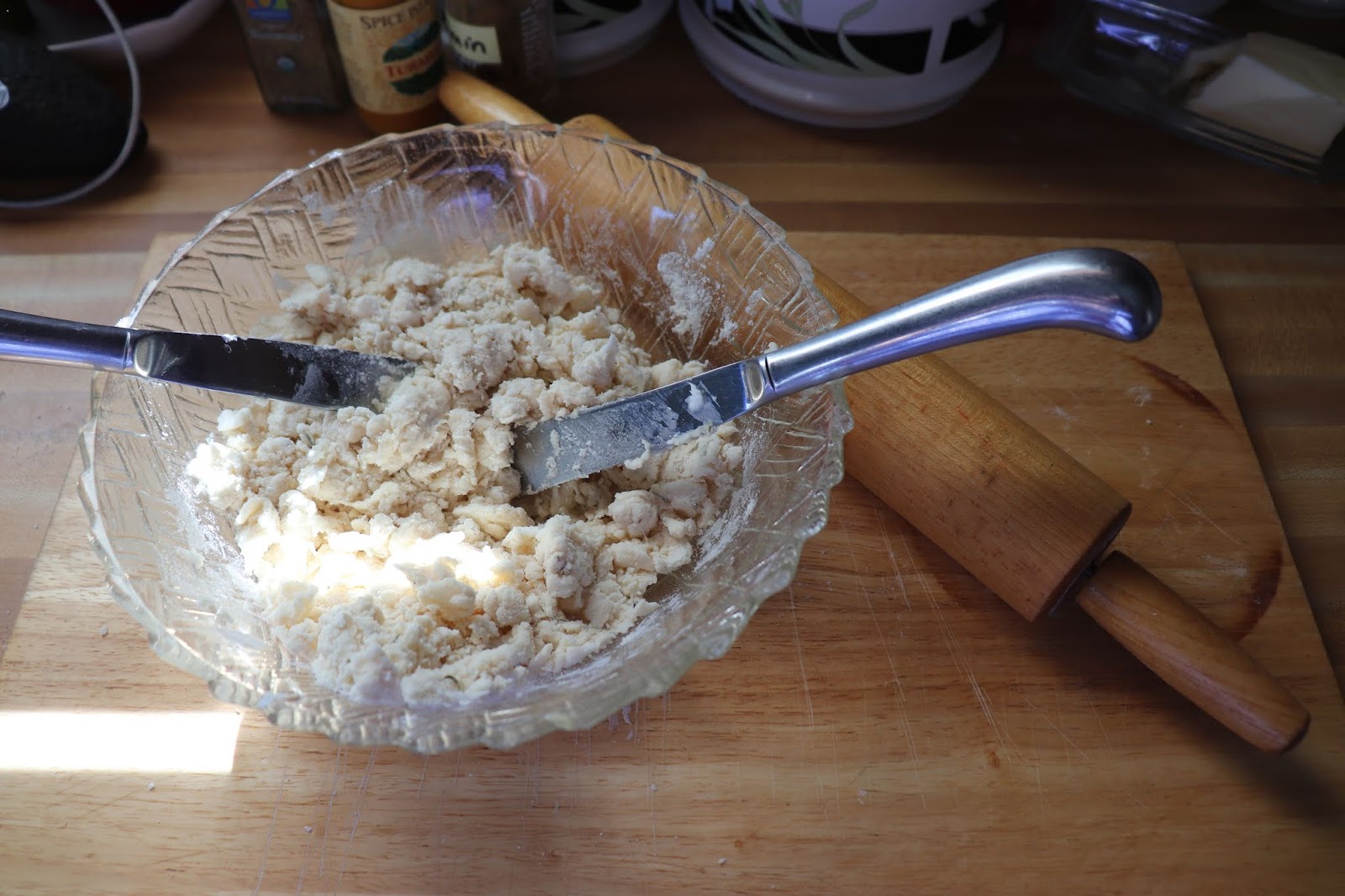
Rosemary and Parmesan cheese added to the dough for the crust. 


(Specks in dough are rosemary.)


I chose to fold the crust over, rustic style, though there 
was a bit much of it for that treatment. Once in the oven, it smelled heavenly. Six million dollar question: How would it turn out?

........

Answer: GREAT!


No kidding, if I had a restaurant, I would put this on the menu! And the pie server recently added to kitchen implements came in handy, too. Altogether, the project and results made for a very cheerful evening.


Thursday, September 1, 2016

Leaving the Kitchen Behind


Balmy air and soft breezes pull me outdoors on summer evenings. They inspire me to pile charcoal briquets on the grill, if only for a couple of pork chops or a small cluster of burgers. On tired and/or hot evenings, however, a skillet in the kitchen and dinner on the porch work out fine, too, as did salmon cooked in a pan, accompanied by yellow rice (courtesy of a friend), and chopped fresh salsa over all.

The rice and salsa worked with chicken thighs and curried yogurt the following evening. That was easy.

And yet sometimes the most dedicated Parisian cook (and we established long ago that I am not that dedicated) wants to do nothing more than sit outside in the fresh air at a cafe table. That's how David and I spent part of Wednesday afternoon in Traverse City while Bruce manned the bookshop counter back in Northport. 

Table in the shade by the side of the Boardman River
Iced peach tea, coffee, and chocolate and lavender "morsels"

View across the Boardman and highway to Grand Traverse Bay

Leaving the kitchen behind does not always demand leaving town. On Thursday, in Northport, at midday, a friend stopped in on her way to the Garage Bar & Grill, right next to Dog Ears Books, and she did not have to twist my arm at all to persuade me to put a sign on the door and lock up for half an hour. We were in heaven! Stella! That took me back to Paris!

Susan had a burger; I had roasted sweet potato. We both had sunshine!
The last day of August, the first day of September: perfect days to relax outdoors, in the shade or in the sun, and let someone else do the kitchen work for a change!

Forager eager for leftovers


Monday, February 1, 2016

Warning: This is Not a Recipe!


If someone, your teacher maybe, ever asks what “irony” or “being ironic” means, you can say it’s when a squirrel says, “our friend, the hawk,” and you will be right. - Lynn Rae Perkins, Nuts to You
How often does the cook in the tiny Paris kitchen have a full-blown dinner plan? In my kitchen, where I’m the cook, rarely, but I usually have some kind of rough starting place, and last Saturday evening the basic ingredient was ground sweet Italian sausage. Earlier I’d had other ideas, plus salad and side dish possibilities, but then left Northport and hurried home without a trip to the grocery store.

I decided on meatballs and began by cubing up three slices of homemade potato bread. Chopped onion, a couple of eggs, handful of rolled oats, bread cubes, Italian seasoning herbs from a bottle (where did that come from?) and freshly ground pepper went into the bowl with the sausage. To firm the mixture up a bit more, I sprinkled in brown rice flour ... mixed ... added a little more flour, then formed the mixture into balls and rolled them gently in rice flour to coat them lightly. Nothing was measured first, and I hadn’t even pulled a cookbook off the shelf.


Into the fridge. Time for a break.

Now here is the irony promised by my opening quotation: While I was making up this dinner main dish as I went along, looking to see what I had on hand and snapping a shot now and then with my camera, a food show on NPR, almost at my left elbow (space being limited), was featuring a guest talking about food blogs and how recipes are absolutely critical and how the only someone who repeatedly tests a recipe can be trusted! Forget the visuals, said the guest, it’s the testing that counts. She gave that advice after noting that many people seem to get discouraged – actually suffer physical anxiety – from seeing too much perfection online.

Well, then, I’m just going to go right on posting a few pictures from time to time, because no one need fear perfection in or from my little kitchen! In fact, I want to say, clearly and emphatically, this is not a “food blog.”

I don’t put myself forward as a chef or wannabe cookbook author. I’m only a small-time bookseller, living out in the country, working out of a tiny kitchen, and trying to keep myself entertained and at the same time keep myself and my husband in good enough spirits to get through another northern winter. Don’t, for heaven’s sake, look to me for recipes! Make things up yourself, if you’re adventurous, and if you’re not, use a cookbook or other recipe source you trust.

Pressure? Stress? Sometimes things work out great, other times a little less than great. Big deal, that’s life. But hardly a matter of life and death.

Thus summarily dismissing blogging concerns, my next question concerned mushrooms: should they be combined with good garlicky chicken broth from last night’s dinner for soup or added to the meatballs? -- After browning the meatballs, that is, and putting them in the oven to take care of themselves while I steal some more reading time.

Decision: meatballs in greased pan, sauteed mushrooms strewn casually on top, broth over all, and into the oven with the entire dish. So many weighty executive decisions before darkness falls on another winter day! 


Reward: another welcome break, off in a larger room.

“Did you take a picture of that?” David asks frequently when I bring plates to the table. I tell him I don’t photograph everything we eat. “Why not?” he asks, when the plates look particularly colorful and appetizing.  Because this isn’t a job. (It doesn’t pay a cent.) It isn’t even a hobby. It’s just life chez nous, and sometimes I feel like sharing it, and other times I’m not in the mood.

So when I do share, like today, pretend you’re joining us for dinner, why don’t you? Or leave a comment to tell me what you made in your own kitchen, large or small, on the last Saturday night in January.


A little contact across the miles helps a lot at this time of year.

Wednesday, December 9, 2015

Of Loaves and Fishes


It was Sunday, December 6.

Sunday again. Bread day. I decided on a light rye, more unbleached white flour than rye but a full three cups of rye and then molasses in place of sugar for an extra kick. But you’ve seen my bread before, and I had posted to this blog only Sunday morning, so I wasn’t feeling pressed to put anything new together right away. Instead, resting on my (scanty) laurels seemed in order.

Moving as usual between one kitchen project and another, however, I could not resist photographing the beautiful lake trout my friend Susan had urged upon me. She had more than enough, she said, and needed space in her freezer for other things. 


Look at this fish! Would you have to be asked twice to accept it? And then, of course, I realized that I had, coincidentally on the first evening of Hannukah, a very Biblical kitchen conjunction of foodstuffs, loaves and fishes. The beginning of the holiday and the unplanned Biblical theme in my kitchen sent me to the shelves to pull out a book.

How do you use cookbooks (if at all)? I have some that are my everyday, pedestrian, basic, go-to reference works, such as Cooking for American Homemakers, first published by the Culinary Arts Institute in 1950; The Joy of Cooking; and the Fannie Farmer Cookbook


And then I have my Paris kitchen daydreaming-and-looking-for-inspiration cookbooks. The Frugal Gourmet on Our Immigrant Ancestors, by Jeff Smith, is one of my favorites in the latter category, the best American cookbook I know for Ethiopian recipes, as well as other surprising national, regional, and ethnic dishes from around the world, along with (gift from friends) The Philosopher’s Kitchen: Recipes from Ancient Greece and Rome for the Modern Cook, by Francine Segan. Yet another is The Complete Guide to Traditional Jewish Cooking, by Marlena Spieler, with recipes from practically every country in the world where Jews have ever lived. Spieler begins the section on bread with these introductory sentences:
At the Jewish table, a meal begins with a blessing over the bread. Bread is one of the most basic foods in the Jewish diet.
Oh, the beautiful breads! How long has it been since I made bagels? And here are recipes for kesra from Morocco, Middle Eastern lavash, pitas and flat breads, Russian potato bread, and Moroccan seed bread. Stollen – that I have made but not for many, many years. Ditto for breadsticks. A world of bread is reaching its arms toward me yearningly! -- No, no! Another time! Tonight only rye bread is on my agenda!

Meanwhile, I decide to improvise with the lake trout in an attempt to please both David and myself. To please myself, I will bake it in the oven, and for him I will devise a light breading involving Parmesan cheese, first dredging the trout in beaten egg, then coating with a mixture of flour, cornmeal and Parmesan. David thinks everything is improved by the addition of Parmesan cheese; to him, its place on the table is as basic as the presence of salt.


Bread dough rising, lake trout popped into the oven, it’s time to saute up some diced onions and mushrooms in butter and olive oil to serve as garnish for the main dish. (Capers and shallots would be good, but those got used up at Thanksgiving and are not yet replaced.) A few tossed greens on the dinner plates for salad. As to a side dish, there’s no space or time (see previous post addressing constraints) to do anything else on the stove or in the oven, so acorn squash, halved and dotted with butter and brown sugar, goes into the microwave. Was it enough? More than.


Although a Pisces, David does not carefully distinguish, as would a Frenchman, among a wide variety of fresh- and saltwater fish. They are all “fish” to him and not usually his first choice if there’s “meat” instead. But this lake trout? Caught in our own Lake Michigan and prepared, if I do say so, to perfection? Well, it raised the bar when David pronounced it “the best fish I ever ate.”

If the rye bread has half as enthusiastic a reception, I thought as I watched the clock and kept my nose tuned to aromas from the oven, it will have been a very satisfying and productive day in the kitchen.
Good bread should have a fairly crisp crust and a soft interior, generally with irregular, slightly glazed holes. Almost no bread should be served hot, and rye bread – the loaf – is best when slightly stale. ... Cool, sweet butter is the best accompaniment. – James and Kay Salter, Life Is Meals: A Food Lover’s Book of Days

Postscript: The bread surpassed my hopes and was everything I dreamed it would be. That doesn't always happen, but it's awfully satisfying when it does.


Sunday, December 6, 2015

On the rue de Vaugirard


Au coin

Forgive the poor quality of this first image, cropped and blown up from a full-size print, itself of unexceptional quality. It was on the rue de Vaugirard (the longest street in Paris, my taxi driver warned when I gave him the street number, he trying to ascertain that I really did know where I was going), in the sixth arrondissement, that I encountered my first Paris kitchen. It was the kitchen of the first apartment I ever saw in Paris, the first Paris building I’d ever been in other than the train station, le gare du Nord.

For years I had been hoarding a few days a year of vacation time, never spending all I had available, until at last I had enough vacation time to go to Paris – for the first time! – for an entire month. All alone! I was going to have, at last, an adventure I had dreamed of all my life. “Where are you staying?” one friend asked. Airily I dismissed the question. I would find a hotel when I got there. The friend was aghast. Most of my friends were aghast, truth be told. One person, I was told years later, predicted that the city would “eat her alive.” “Her” being me, of course. Others told me I would hate Paris because Parisians were rude and hated Americans. I dismissed that silliness out of hand, sure that Parisians would love me, because I would be so happy to be there.

I did not take Paris by storm, but on that first visit I formed a friendship with a woman of my parents’ generation, a friendship that endured to the death.

Back home, the friend who had asked where I would be staying had been in Paris the previous year, and he contacted a woman from whom he had rented a room, although I already had plane tickets and would be arriving on the last day of April (2007), to stay through the month of May, whether or not that particular room might be available. Madame replied that she had only one month still available for the entire year – the month of May. I was in!

It was an exhausting flight on Icelandair, from Chicago via Keflavik to Luxemburg, where there was a long layover in a train station with waiting room seating accommodations only for first-class passengers. I hunkered down on the floor with my bag, willing the hands of the clock to move. Hours later the train to Paris began boarding, but I still had nowhere to sit: I had a ticket to ride but no “reservation,” a separate expense that would have guaranteed me a seat. Without a reservation I had to stand up, exhausted, swaying, almost until my destination was reached.

Midnight. Back in Michigan it was 7 a.m. I had been awake for two nights already. Yes, I assured the taxi driver, I was certain of the house number. And I had the all-important code that would get me into the building.

Un escargot
A beautiful stairway led up to the apartment of Madame Hélène P. Up and up and up I went with what now felt like a bag of cement. On her door was a little handwritten note, saying she was downstairs on the first floor, visiting a friend! I staggered back down, taking the bag along, unfamiliar with the city and the building and its inhabitants and customs. Mme. P. and her friend, Mme. L., tried to urge on me a cup of tea, a bite of something to eat, but all I had strength to do was to fall on a bed, and so, back upstairs and into – my room!


The room she rented out by the month – under the table, bien sûr, since the apartment was rent-controlled but because only with the income from the room could she manage to survive – was much larger and more generously furnished than her own bedroom. I had what seemed an enormous bed with small tables on each side, a fireplace surmounted by a mirror, a large table for writing, and a closet. The bathroom, c’est-à-dire, la salle de bain (not la toilette, which was in a separate, small, windowless room on the other side of the kitchen), with large tub and shower and bidet and window and rack for drying hand-laundered items, was between the two bedrooms, but my landlady seemed to regard it as mine, for some reason. Because I was a paying guest. When she asked me once, apologetically, if she might have a bath, I was shocked. “Mais vous êtes chez vous!” I told her. It was her home! And yet, dependent on her sub rosa rental income, she wanted her renter to be happy.

Hélène et Sirius, son chat
How could I not be happy? That first morning, hearing French voices through the open windows, the thrilling, chinking sound of spoon against coffee cup, the cooing and purling of pigeons and occasional flutter of their wings!

I would go out every morning, having studied my map and bus schedules and chosen a direction and one or more destinations for the day, but I only took a camera with me two or three times, near the end of my time there, because more than anything else I wanted to be where I was, immersed in the sensations of the moment and not viewing objectively through a mechanical lens. In the evenings, Mme. P. and I would sit together at her dining table, which also held her small television set, and she would watch tennis matches or work crossword puzzles, and I would write letters home, but our conversations gradually became more important to both of us. Hélène spoke no English, which was ideal from my perspective, as it forced me to rely on and improve the high school French I had been struggling to retain for so many years. We generally had a dictionary or two on the table between us, as well as a pad of “bloc-notes,” that peculiar paper the French seem to favor which instead of being simply lined for writing is broken up into a blue grid of small squares. If either of us could not make out what the other was trying to say, we would resort to pen and paper.

I saw myself in that era of my life as remarkably independent and self-sufficient. Hadn’t I gotten myself across the Atlantic Ocean, and wasn’t I making my way around a cosmopolitan world city day after day, all alone, in an acquired second language? Mme. P. saw me, I later learned, as “fragile,” and in a number of small ways she took me under her wing. When I brought home a bottle of red wine one evening, wine I thought incredibly cheap, she told me not to waste my money so extravagantly, that she would keep a bottle filled for me from her supply of bulk wine. She cleared a shelf in the refrigerator for me and kept a bottle filled with wine for me on that shelf. Next she offered to take me to the nearest neighborhood produce market, her favorite, one alas! now replaced by modern apartments. And after carefully noting my generally frugal (apart from that first bottle of wine) and tidy ways, she extended kitchen privileges to me. Cooking in Hélène’s kitchen did not come automatically with room rental. It was a privilege that had to be earned.

Another “alas!” is that I have no photographs of the kitchen, nor did I keep any kind of record of what I cooked in it. I remember an artichoke one evening. Another time I returned alone to the market Hélène had introduced me to and requested an avocado of a Vietnamese vendor. “Pour manger quand?” he asked. When I intended to eat the avocado determined the one he would choose for me. I also had a little beguin (a weakness) for all kinds of French sausages and related products. The variety dazzled me.

Later I would come to know the wonderful market street of the ninth arrondissement, la rue des Martyrs, and when to pronounce or not pronounce the final ‘s’ of the word plus when buying a tranche of cheese, the difference being more or no more.

Fromages!!!

About halfway through May, Hélène and I had progressed to addressing one another by the familiar tu, and it’s hard to say which of us was more touched by the conversational intimacy. For me it marked a first; for her, it might have been one of the last. When I returned to Michigan, we began an exchange of letters. And earlier this year, when I plucked I Know How to Cook, the English translation of the basic French cookbook, Je sais cuisiner, off my shelf, out fell letters from Paris.


I was transported. My friend, who died at the age of 90 about a decade ago, was alive again as I re-read the letters. The last one, I realized more than I had when first I received it, was one she knew would probably be the last she would write to me. It expressed how deeply she valued our friendship, how much I meant to her, but she also admitted that she had little desire any more for her own life, that she had become “a bit of a spectator of the end of [her] life” (un peu spectateur de ma fin de vie), though she retained her love of nature – the sky, clouds, cats, and “animals in general.” Always she closed sending kisses to my dog, a dog she knew only from snapshots.

I saw her last in September 2000, but Hélène is with me still, in my little Paris kitchen in my old Michigan farmhouse. It was Hélène who encouraged me to eat asparagus with my fingers, peasant-style (Hélène was artistic, well read, politically and socially well informed, and the same year I met her I began graduate studies in philosophy, but both of us came from peasant stock and were proud of that heritage), and even now, in spring, when Michigan asparagus is so tender and green, I wish I could have introduced my Parisian friend to the way we know the vegetable here Up North.

Ma chère amie, Hélène, tu es encore dans mon coeur et vraiment dans ma vie quotidienne. Quand je faire du pain, quand je bois du vin, je pense à toi.

The kitchen in my Michigan farmhouse, small as it is, overflows with dear, ghostly presences, and for that I am grateful. I would not have it any less crowded for the world. Here is the pasta maker given to me by another friend back in the 1970s. I think of her every time I use it. She died this year, but she also is alive in my Paris kitchen.

Pasta maker from Linda

Homemade noodles

Noodles and gravy