Search This Blog

Showing posts with label family. Show all posts

Wednesday, December 5, 2018

Kitchen Memories and a New Specialty From the Oven


Winter arrives, and the kitchen beckons. Holidays approach, upping the ante. Holidays increase both a slightly anxious pressure and the happy or bittersweet weight of memories. The other morning, the first text of the day from the younger of my two younger sisters was this: “It’s been three months, sisters.” Three months since our mother died, that is. That loss, still sharp, is now accompanied for us by all our family memories of holiday kitchen projects: cookies we helped make and decorate from the time we were little girls; our mother’s amazing marzipan; her special coffee cakes; those intricate, magical sugar cube houses that sat on the sideboard, nested in a bed of cotton “snow” and surrounded by candles in the shape of pine trees; her inimitable peanut brittle; and so much more. I get out her old, old cookbook and turn the pages, where the most meaningful recipes to me are not those cut from magazines and taped in but the ones she copied out in here own hand. Handwriting on paper! How could anything “digital” hold so much of a person’s essence?


My only actual baking this year, however, came from a recipe on the inside of a box as, for only the second time, I set out to make peanut butter cheesecake brownies. On the first trial, a few months back, I had baked the brownies in muffin tins and was happy enough with the results that I wanted to experiment further in that direction. Hence the mini-muffin tins, with individual cups the perfect size to duplicate bite-sized cheesecake brownie treats (well, more like three bites each) that I’d discovered in a grocery store bakery in the Southwest.

(Measuring spoons for scale)
The recipe on the box was clearly written for people in a hurry, because it told me to melt the chocolate and butter in a microwave oven. Call me old-fashioned (you won’t be the first), but I prefer to use a double boiler, especially with the other changes I was making to the process. While chocolate and butter were melting, you see, I had time to grease my muffin tins. Of course, the recipe people had not foreseen the use of muffin tins so cannot be faulted, I suppose, for trying to rush the process. 


*** Excuse me, though, because here I have a thought that is a complete digression from memories and brownies but important enough that I want to interrupt myself to get it in. All these “quick” recipes that call for “instant” mashed potatoes and “instant” oatmeal? Please, please, please don’t do that! You might as well just sit down and eat a bowl of sugar! You think “it’s good for them in a casserole or a cookie”? No, not that pre-digested stuff: it leaves your digestive system nothing to do and does nothing for you but prime your system for more sugar. End of lecture. ***

Baker’s Chocolate instructions were at first somewhat confusing to me when it came to the eggs. They called for five eggs, “divided.” I never heard of “divided” eggs. Did they mean separated? Well, clearly not, because further along the eggs, not egg yolks and egg whites, were to be added — but not all at once to the same bowl. What the recipe had intended to forecast was that four eggs would be added to the chocolate mixture and one to the cream cheese and peanut butter mixture. Okay, that's settled!


Then there was the matter of swirling the peanut butter and cream cheese and sugar mixture (2-1/2 cups of sugar were also “divided,” 2 cups going into the chocolate/butter mix and 1/2 cup into peanut butter and cream cheese) into the chocolate mixture that also had flour added last. In a pan, swirling can be done with a knife, but in the tiny muffin tins only a toothpick would do the job. 


Do they look messy in the pans? I had moments of doubt at this stage.


Time in the oven for the different variations had to be adjusted by guess and by gosh, since brownies in the large muffin tin did not need to bake as long as those in a traditional cake pan, and those in the mini-muffin tins baked fastest of all. A watchful eye, initial short baking period, and an additional five minutes here and there seemed the recipe for success. It would depend on your ovens and your pans. 

In the end, all variations produced acceptable results, and though my mother never used this basic recipe, as far as I can recall, I could easily imagine her sitting at the table nearby, following the entire procedure, getting up to examine the brownies as they came out of the oven, and eventually giving them the taste test and pronouncing them “Very good, sweetheart!” 

My sisters and I returned to our morning text-fest, remembering a year when our grandmother was with us for the holidays and we had an old-fashioned taffy pull in my mother’s little kitchen. Small, that is, but not as small as the one I call my “Paris” kitchen. Still, my mother’s kitchen was probably good training for not letting lack of space get in the way of cooking and baking. 


My mother and grandmother are with me still when baking season comes around, as they are with my sisters, and we are fortunate to have memories to share.


Monday, January 18, 2016

Everything But the Squawk


Nature determines not only what the menu shall consist of in any given region, but often as well what selection will be made from the various possibilities and how they will be prepared. 
 -      Waverly Root, The Food of France   

While the rich and noble were enjoying their rarefied existence, the country people lived off what they could grow, rear or barter. Throughout the vicissitudes of French history, away from the capital city, Frenchwomen sought to feed their families, and especially their children, as best they could by relying on their own inventiveness....  
Most of these recipes therefore belong to a feminine tradition....  
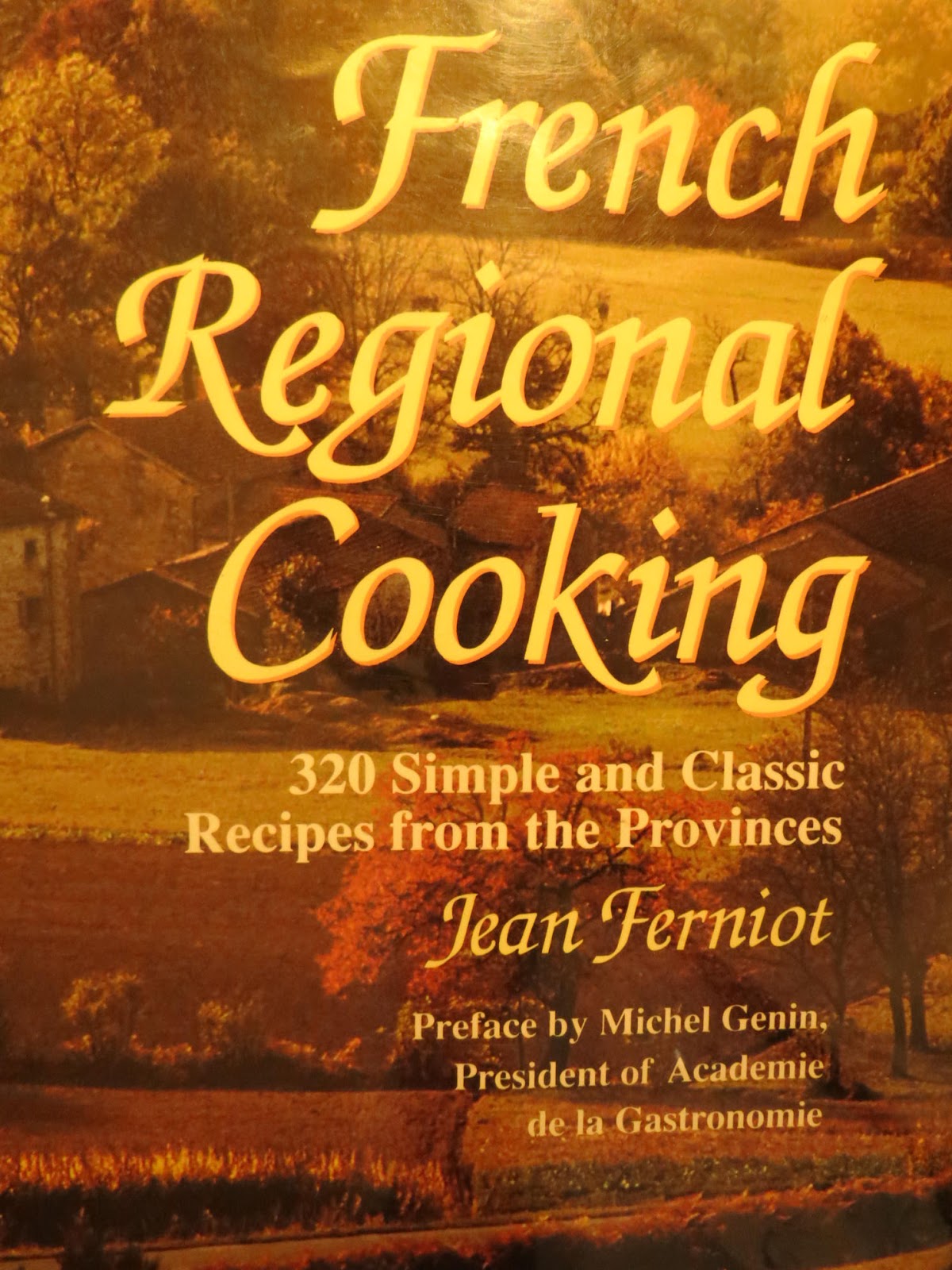
-      Jean Ferniot, French Regional Cooking
The traditional French country kitchen was a frugal place. Nothing was wasted.

In peasant life, from time immemorial, where the means to keep body and soul together must be won from Nature through great physical effort, frugality has been a necessary way of life. A similar way of life is thrust upon others the world ‘round, not all of whom off the land or even in the country. Anyone whose livelihood is lean and uncertain had best be frugal. It occurs to me that something like what is said of greatness can also be said of frugality: some women are born frugal; others have frugality thrust upon them.

My grandmother, I think, would be proud of my ways with a chicken.

A second-generation American, my maternal grandmother came from mixed European peasant stock and married the poor Irish immigrant to America who became my mother’s father. (Not yet a citizen, that immigrant nevertheless served in the U.S. Army in World War I.) Following the early end of that marriage (facts shrouded in mystery), my grandmother made a love match with another poor man, a Florida “cracker,” and the two of them moved around the country from job to job, from one town to another, from coast to coast during my young mother’s toddler and little girl years until finally, when my mother was an adolescent, they settled on a small plot of land outside Springfield, Ohio.

What my grandmother called their “farmette” was certainly no more than five acres and quite possibly less. To the child I was when staying there, no doubt it seemed to me much larger than it was. They had space enough, anyway, to keep a cow for milk and to raise chickens and fruits and vegetables, the cow and hens my grandmother’s, orchards and gardens my grandfather’s domain.

Their house was modest in the extreme. Two small bedrooms (and only two, though the family produced a younger brother and sister for my mother during the Ohio years) had nothing but sheets hung in the doorways for privacy – no doors that could be closed. At the end of a long brick path through the backyard orchard -- the bricks laid out in a herringbone pattern and the path shaded by trellised grapevines in summer -- stood the wooden outhouse, a place of terror for my next-younger sister, with its spider-hung interior and outside eaves decorated with nests of wasps and hornets. While the house had no modern indoor plumbing, a hand pump raised to counter height in the house’s shedlike kitchen annex saved my grandmother the bother of going to an outdoor well for water. This, by the way, was in 1950s postwar America.

The road that led to the house was unpaved, and all the children who lived along the road, black and white, went barefoot all summer long. How many had shoes at home, I have no idea. I was happy enough to be shed of mine! Everyone had dogs and cats and gardens, however, one or two families had ponies, so how could I see the neighborhood as disadvantaged?

When my next-younger sister (she of outhouse trepidation) and I were left with my grandparents for an entire month one summer, I felt as if I’d gone straight to heaven. In the road and driveway, clay dust as fine and soft as talcum powder caressed my feet, and, little sensualist that I was, I squiggled it happily between my bare toes. Trees to climb and leafy branches to hide in were everywhere! My grandmother assigned me chores, but helping to feed chickens and string beans and setting the table for dinner left me plenty of hours to run joyously “wild,” alone or with the neighborhood children. Much of my time, in fact, was solitary, but never lonely, thanks to an imagination as wild as coltish legs and grasping monkey hands. Never in my life, I think, have I felt as free and as thoroughly myself as during those weeks of what many would see as rural poverty.

The land put food on my grandparents’ table directly and, through my grandmother’s sales at the city’s farm market, indirectly, augmented by my grandfather’s labors at a daytime factory job. My grandmother was a master of “slow cooking” because that is what cooking was to her. She knew better than anyone that ingredients could not simply be thrown together and heated, that they needed time to “get good.” I can close my eyes see her, standing at the stove, spoon in hand, tasting to see if her goulash was “good” yet.

As a child of six, seven, eight and nine years old, I gave little thought to frugality, but with so little money in the house and many mouths to feed, my grandmother obviously had to be frugal. When my sister and I were part of the household that summer, we also couldn’t help noticing that certain people from the neighborhood, usually single men, often dropped by just as dinner was coming to the table. My grandmother always set another place, quickly, no questions asked.

“Why would she do that?” someone who is no longer part of our family (!)  once asked in offended self-righteousness as my sister and I were recalling childhood vacations in Ohio.  The questioner saw in the story nothing but lazy freeloaders taking advantage of hard-working people. “Why? Because they were hungry,” my sister answered. Wasn’t it obvious? Turning someone away was not my grandmother’s way. She was frugal, not stingy.

Winter is a lean season for a bookseller in a summer resort town. When I buy a whole roasting chicken at the grocery store, I think of my grandmother culling one from her flock to bring to table, and I think she would admire my resourcefulness: stuffed roast chicken, leftover roast chicken and stuffing, chicken noodle soup, chicken sandwiches, chicken pot pie, more chicken pot pie, and the last of the chicken soup. That’s a week’s worth of meals from one bird. (There was gravy, too.) The pie takes the most time to prepare but is also one of the heartiest meals of a chicken week, with whole wheat crust and generous filling of cubed chicken, onion, mushrooms, green peas, sliced carrots, and cubed sweet potato in a Béchamel sauce. And it smells so good coming from the oven!


Cooking in Paris apartments is not always what it used to be. There are stores now, right in Paris, that stock nothing but frozen foods, including entrees and desserts. Do such stores exist in the provinces, too? I wouldn’t be surprised. I’ve known one or two French refrigerators that held yogurt in multiple, very tiny individual-sized containers, rather than one large one.  As for making yogurt? Well, I did that a few years ago (in Aripeka, FL, and posted on Books in Northport, but do you think I can find the post?), and maybe should take it up again this winter. I still have the little yogurt maker, and just thinking about it I’m feeling inspired. The point I started out toward, however, is that making their own yogurt isn’t something many household cooks are doing these days, either in Paris or in the French countryside. In that way, as in so many others, my “Paris kitchen” is not all that French.


Well, I have made a ‘mishmosh’ of this post, as M.F.K. Fisher wrote often in letters to friends – my Paris kitchen, Parisian and French provincial cooking, my grandmothers’ country life and ways, my own winter meals. But I did have a theme: FRUGALITY! So in closing let me say that pinching pennies need not be a “dismal science” but can be an inspiring and enjoyable challenge to the cook, whatever the size of her kitchen.

[Note: In the final sentence above, please note I am using the generic ‘her’ to indicate her or him.]


Wednesday, September 23, 2015

A View Into the Kitchen, a Breakfast Casserole, and a Company Dessert


The kitchen in our old farmhouse is very small. In the photograph above, you are looking through the doorway (there's no room for a door) into the kitchen. Three or four steps, depending on the length of your stride, would take you from the sill to the back wall, and from side to side, there's no need to take steps -- just turn from sink to stove. Because it is so small, I call it my Paris kitchen, and I've written on my main blog, Books in Northport, about how I started calling it that.


There's no dishwasher in my (Up North Michigan) Paris kitchen and no window to look through during my dishwashing meditations. When I'm outdoors, I'm outdoors. When I'm washing dishes, I'm washing dishes. Or looking up at pictures of different breeds of chickens and dreaming of having live ones outdoors....

Despite the modest size of the kitchen, I finally treated myself to new appliances in 2015. Our brand-new refrigerator has a separate door for the freezer! The brand-new stove has a working oven! My new kitchen appliances are larger and more modern than the ones Julia Child had in Paris, and I'm no Julia Child, so they are all I need for the rest of my life.

The package on the counter above -- can you see it? -- is organic bacon from "the meat lady" at our summer farmers market. Below is the same bacon sizzling in a pan, and beneath that is the breakfast casserole I put together on Sunday morning for my visiting mother and sisters. 


Sadly, I completely forgot to photograph the casserole when it came out of the oven. Sorry!

David often asks me, when I bring dinner to the table, "Did you take a picture of that?" and I wave away the suggestion. During my family's recent visit, however, following a recipe from Jayne Robinson's The Cake Chronicles, I thought photographing my attempt at different stages might not be a bad idea -- and, in fact, I had done so last year, when making another recipe from the book, and when I became convinced that I needed an electric mixer: my fresh tomato cake last year, batter beaten by hand, while delicious, was just not as light as a cake should be. 

For this year's family reunion dessert, I decided to make what Jayne Robinson calls a Michigan sour cherry pudding cake. My mother and sisters and I agreed that we would call it a Michigan sour cherry custard cake, as the milk and cream and eggs deliver a texture and flavor more like custard than either pudding or cake. French Regional Cooking, by Jean Ferniot, another book I consulted, gives the alternate English/American name as cherry flan. The cherries I used were organic Balatons, and I pitted them hastily before freezing, racing the fruit flies, which explains the appearance of the dessert, both in process and in finished form.

Tart cherries distributed over half the batter in pie pan

Remaining batter poured gently over

Finished dessert, out of the oven

My cookbook of French regional recipes calls this by its traditional French name, clafoutis. It's a specialty of the Massif Central region of France, where I fell in love with the old province of Auvergne, though this recipe comes from the Limousin. Both Jayne's recipe and the French cookbook recipe call for 1/4 cup of heavy cream, but then Jayne uses 3/4 cup of milk and three eggs, while the French leave out the milk entirely and use eight (8) eggs.

French cookbook shows clafoutis made with unpitted cherries

But I did it Jayne's way, and that was a sufficient number of eggs for us. It also let me use whole milk from Shetler's Dairy. The great thing -- a bonus -- about needing heavy cream for the batter was having the remainder to whip for dessert topping. As for the hard stuff, French Regional Cooking called for kirsch, The Cake Chronicles for cognac, but I used Redbreast, because it's what I had on hand, left from a sister visit in August.

The cherries were pitted a few weeks back on my front porch, and my family and I enjoyed our dessert this past weekend on the front porch, but the dessert itself came out of my own little Paris kitchen. It tasted even better than it looked.