Search This Blog

Showing posts with label France. Show all posts

Saturday, November 11, 2017

Memory's Lasting Perfume


When snow arrived this week, I brought my rosemary plants into the house. Rosemary is a tender herb, native to hot, dry climates like Provence, and will not survive a winter outdoors, so one of my Friday projects was to strip the fragrant leaves from the longest stems for winter drying. Because the resident Artist, in his home office, has the only south-facing window in ou4 old farmhouse, that is where the remaining trimmed plants are resting for the time being.

My friend Helene referred to her dining room windowsill of plants, fresh herbs and a few pots of blooms, as her garden, and early on during my stay with her we established our mutual love of growing things. Years later (and years into our transatlantic correspondence), when I came to live here in the farmhouse, I would sometimes sit out by my vegetable garden at sunrise and write a description of the scene to my faraway friend, who was kind enough to praise my laborious essays — truly, attempts — in French. 


At last one year I received no answer to my last letter for a worrisome length of time and got a disturbing recording when I called her phone number. I telephoned her downstairs neighbor, heart pounding. Yes, Helene had died. She was then, after all, 90 years old by that time and had had health issues for all the years I’d known her, but the shock was no less painful for being unsurprising. And Mme. Lamy could not help telling me, over and over, that Helene had “suffered terribly.” Each time she said it, I recoiled from the painful stab of that awful phrase. But Mme. Lamy also told me, several times, how happy Helene had always been when the mail brought a letter from me, and I take comfort still in knowing I gave her some little bit of joy now and then. 


Rosemary is good for flavoring vegetables and meats, especially suckling pig, veal, lamb and game. It keeps its pungency well when dried. Use this herb with moderation, as it has a very strong aroma and flavor. - Ginette Mathiot, in I Know How to Cook

Never in my life have I prepared suckling pig or veal, but I do love lamb, and there is no cooking or even living without vegetables. 

The New Putting Food By (not that “new,” actually, as my third edition has a 1982 printing date) cautions that rosemary must not be dried at higher than room temperature and dries best away from light. Just as well. Moving the rosemary-drying operation upstairs means not adding one more project to our crowded downstairs living space, where my apple-drying project continues in full swing evening after evening. 


Rosemary is one of the flavors (un des parfums) in the beloved French mixture called “herbes de Provence,” which sometimes includes lavender, too, along with other herbs. It was in Paris that I came to know and love and require herbes de Provence in my cooking on a regular basis, and so for that reason, along with my memory of my friend’s windowsill garden, Helene is very present to me as I handle these sharply fragrant leaves.


Is there someone in your life whose day would be brightened by a letter from you?


Her letters brought joy to me, too


Monday, May 1, 2017

Thirty Years Ago Today


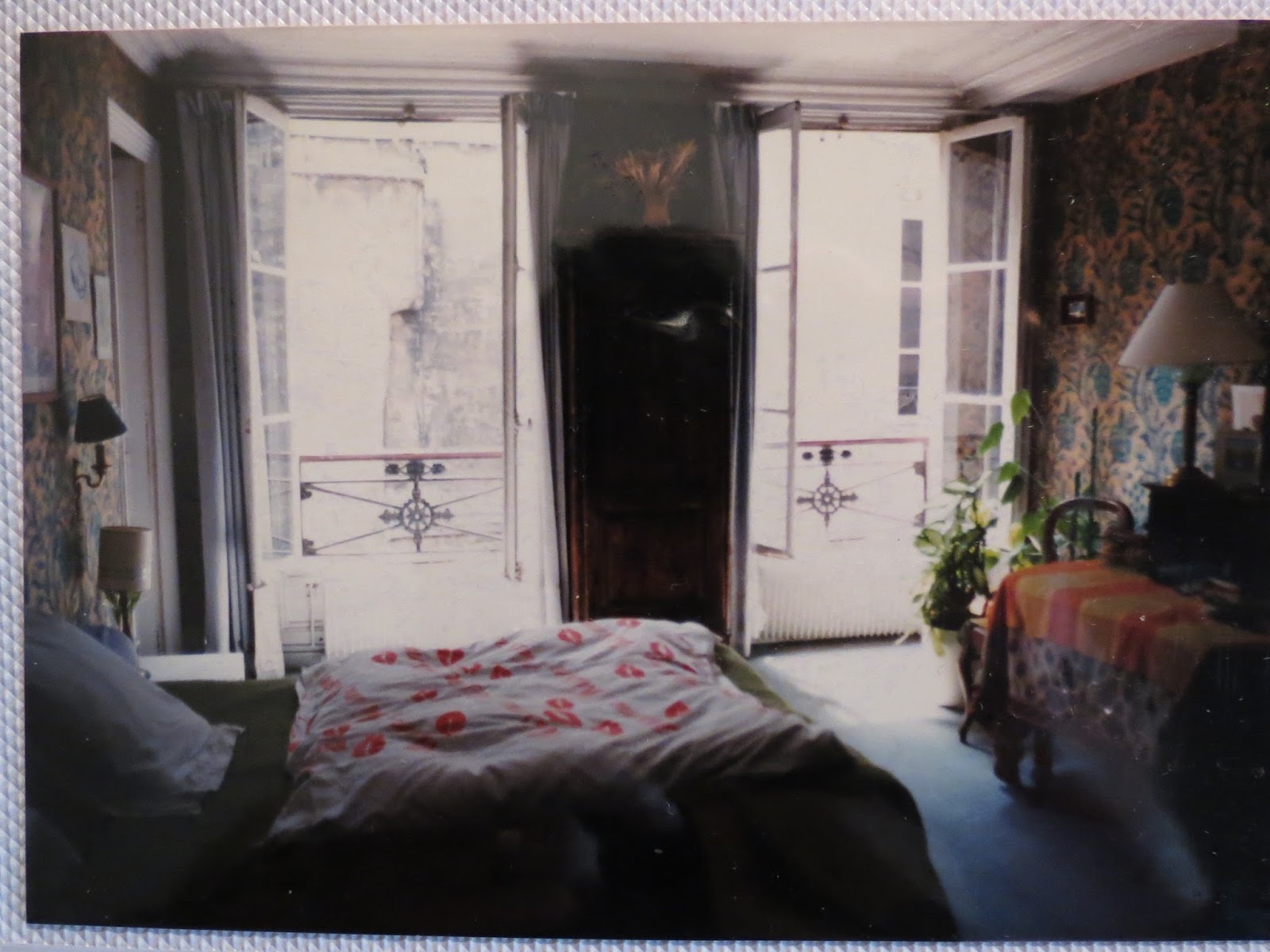
Thirty years ago this morning I awoke in Paris to the sounds of cooing pigeons and the voices of Frenchwomen at their morning household chores coming through tall bedroom courtyard windows. On the nightstand beside my bed was a pot of lilies-of-the-valley. I had arrived at midnight the night before, exhausted after two nights without sleep, a transatlantic flight, hours crouched on the floor of the railroad station in Luxembourg (waiting room with benches only for first-class passengers), a train ride made mostly on my feet (I had a ticket but not a seat reservation), and, after a confusing taxi ride in the dark, a climb with heavy bag to the third floor of 39 rue Vaugirard, where I found a note on the door telling me that Mme. Pillet was downstairs at a friend’s apartment. Down I trudged to find her. Back up again. Did I want something to eat? Wasn’t I hungry? No, I needed to fall into bed as quickly as possible before I keeled over onto the floor!

In the morning I woke refreshed. It was a sunny morning. The soft pigeon sounds, the flute-y women’s voices, the sweet chink of spoons against china cups—purling, murmuring--seemed too beautiful to be real.


Hélène made coffee for me that first morning but warned me she would not do so regularly. She did, however, as she realized I would not be a slovenly renter, extend to me kitchen privileges not accorded to all who stayed in the room, and by the end of the month, when it came time for me to leave, we were close friends.

Being there. Nothing at all like looking at pictures or watching a movie or reading a book or imagining! The ancient city filled with lilies-of-the-valley, pots and bouquets and corsages of them everywhere. The Seine sparkling in the sun.

And so on May Day I remember that morning 30 years ago. A day to celebrate friendship, a holiday from work. For me, a dream come true that lives on, cherished, in memory.


Monday, January 9, 2017

Winter Fare: Gophers and Stone Soup

Stones at mouth of Hurricane River


I was just kidding about the gophers. What I mean is waffles.

Warming plate while waffle iron heats

In Paris, France, waffles are street food. Hot gaufres are served up by vendors in parks who sell their food out of little carts, small mobile kitchens. Like ice cream cones, gaufres are favorite treats of small children but enjoyed by adults, also, perhaps especially by visitors from the American Midwest, to whom street food is a novelty. A favorite French waffle topping – there are many, but this was my favorite -- is almond paste, smeared on like peanut butter on crackers, then sprinkled with powdered sugar.

Out of curiosity, I checked in my French cookbook to see if it even contained a recipe for waffles. Would anyone in Paris ever make them at home? Well, there was a recipe, in fact, but in the section on cakes, on the page opposite fruit cake and jelly roll. It calls for fresh yeast rather than baking powder and also, to my surprise, includes rum, an addition that would never have occurred to me.


Last yummy bite!
For Americans at home in our own country, waffles are breakfast food, but they are a sweet treat here, too. The small, square depressions produced by the iron form a dozen or more tiny receptacles for melted butter and syrup. Jam is a delicious variant topping, and then no fork is needed. Dreaming of Paris, one can pick up a waffle section with fingers, confident of capturing every last morsel of confiture de pêches (thank you, Ed!) or, when that’s gone, good old Michigan strawberry-rhubarb jelly.

We are not talking here about an everyday breakfast, of course. Not the beginning of an ordinary workday. It’s holidays and Sundays that call out for the extra sybaritic excitement only waffles can bring to an otherwise cold, bleak winter morning.

Outdoors the temperature rests, stubbornly, well below the freezing mark, and wind blows fresh snow into blinding drifts. A frigid Sunday morning in January! What better day to stay home by the fireside with dog and books and movies?

Beautiful, beantiful beans!

More stones
Meanwhile, in the big cast iron pot that rested overnight on the cold porch is the bean soup that will be the evening’s hearty peasant supper. On Friday night, as I first covered the colorful beans with water to begin soaking, I thought again, as I have so often before, that they are as beautiful as wave-washed stones on the shores of Lake Superior. Stone soup? Why not? Dry beans lose their bright colors when cooked, but the flavors that develop are worth the trade-off.

Slow cooking. David is always encouraging me to use an electric slow cooker for dishes like bean soup or stewed chicken, but I resist. There is something about that ceramic pot and the way its unlifted lid -- one is instructed rather severely not to lift the lid during cooking! – the way, I say, that lid holds in all the dish’s moisture that, to my way of thinking, prevents precisely the rich, concentrated flavors that are my goal. -- Oh, dear, my italics are running away with me, escaping from foreign words and phrases to the equivalent of a raising of the voice! Yes, it’s true, my emotions are involved!

Where was I? Ah, yes, concentrated flavor.... And besides that, I like to lift the lid! I like to stir the contents of the pot! Stirring the pot makes me think of my grandmother at the stove, and I love remembering my grandmother! I even like to leave the lid off for periods of the cooking process as the bean liquor thickens and steam rises and an alluring aroma fills the old farmhouse. These are some of the joys of winter in Michigan: tastes and smells and leisurely activities mingled with memories.

Far from Paris, you see, I carry that city in my heart, along with the U.P. and Ohio and the Illinois prairie and the Arizona cow country and every other place I have ever lived and cooked and eaten, and in my mind’s eye I see again long-vanished scenes and am warmed by thoughts of family and friends and even strangers who shared those bygone days.

What is the point of having a day to spend at home if I am to deny myself the pleasure of stirring the pot?

Well-stirred bean soup


Tuesday, November 1, 2016

Because Winter Is Coming Again


For the second year in a row, the countryside failed to yield up much in the way of wild grapes. Grapevines, yes. Everywhere! But grapes? One measly cluster along a road where I've gathered grapes by the bagful in past years. 

The usual berry-picking spots around our farmyard held back fruits, too. And so – no 'blackstraw' (my blend of strawberry, black raspberry and wild blackberry) or mixed fruit jam this year. In fact, no jam at all.

But it’s been a plentiful apple season, I’m happy to say, and I’ve gotten in a good couple sessions of peeling, slicing and drying apples for the winter. 

My son visited, and we harvested apples together
Five such layers deep
Without sulphur, they brown slightly. Fine with me!

Applesauce, too, has appeared regularly on the farmhouse table. Purée de pomme, the French would say, but I generally leave mine chunkier, in keeping with its rustic origin: wild apples or those from my farmyard trees, gathered in a basket or string bag, and brought back to my tiny country Paris kitchen. Nothing fancy.

Friends of mine have recently returned from a trip to France, and I am eager to hear their stories and see their vacation photos. They visited many bookstores, I’m happy to say, and brought back treasures in book form. While they were in the capital, I’m sure they noticed that French provincial cuisine is as common as the haute variety. The population of Paris, like that of New York, has always drawn from throughout the country and around the world, so Paris restaurants and Paris kitchens are often not fancy at all. Not big, either. Modest, like mine.

Bookshop my friends visited in Paris, France


Saturday, May 7, 2016

From Spring Woods to Farm Kitchen


You’re probably expecting, from my subject heading, either morels or wild leeks, but I want to introduce you to a less well-known Up North spring delicacy. It is the humble cutleaf (or cut-leaved) toothwort (also known as crow’s toes or pepper root), found from eastern Canada to Florida.


You can walk in the woods for years without noticing it, as I did. Then one day you make the identification, and from then on you watch for it eagerly every spring. Here is a site that keys it as a Brassica, i.e., a member of the mustard family. Its name has apparently been changed, just like my old childhood friend Brontosaurus, whose new name will never be lodged in my long-term memory. -- Whoa! Here’s good news for my generation: Brontosaurus is Back!!! Well, I'm glad I looked that up!

Anyway, toothwort. I am bound and determined to keep in the mustard family. Look at the four-petaled flower, and try to deny the family relationship.


My point – and I realize I’m taking forever to come to it – is that the peppery leaves and flowers of toothwort are a welcome change from the store-bought lettuce (and even kale) we’ve lived on all winter. I went to the woods on Friday afternoon and picked me a nice mess.


I chose the bland smoothness of tofu to offset the peppery greens. (If you don’t make your own tofu but live in the Grand Traverse area, the best available can be found at the Oryana Food Co-op in Traverse City.)


I dressed my salad with a little olive oil and very small dash of balsamic vinegar, whisked together with a smidgeon of Grey Poupon. And that was that, except for a sprinkling of hard-cooked egg yolk on top. If you don’t care for tofu, you might substitute the white from the hard-cooked egg – an easy exchange.


We seem to have strayed far from Paris today, but it’s that time of year – time to get out into the northern Michigan woods. Although I wouldn’t be surprised to learn that toothwort or something like it can be found in the forests of Europe. We are, after all, at about the same latitude, and many of our plants are common to both continents. And who knows better than the French about foraging in the woods for kitchen treasures?


Friday, April 29, 2016

A Friend's First Trip

My friend Ed is going to France for the first time in June, not only seeing the sights but also studying French and taking a cooking class. You'll be able to follow his adventures here. I certainly plan to tag along via his blog.

Sunday, March 6, 2016

Senses in the Kitchen, at Work and at Play


No doubt synesthesia was born long ago in the wild past of our early evolution, but it is just as surely reborn in the kitchen. When you see fat leeks in the grocery store produce section or smell the earthy freshness of dainty wild ones in the woods, don’t you already feel their smoothness in your mouth? What about the color? My eyes see green, but my mind reads purple, the smooth purple of an eggplant, and my ears hear the rich, dark music of a bassoon or a cello.

Leeks, along with daffodils, are associated by the Welsh with the Feast of St. David on March first. I missed the day again this year. The first of March is too early to look for leeks and daffodils in northern Michigan. So let’s come back indoors, back into the kitchen, and sift through memories and towels.

I am hopeless when it comes to sewing. My mother loved to sew – sewed new dresses for my sisters and me all the time when we were little -- and couldn’t understand how trying to follow a pattern could reduce me to tears. I was proud of my skill in threading the machine, both top and bottom threads, but had not joined 4-H in order to make aprons and skirts! In my mind, 4-H membership was the first step to getting a horse!
Horses = Heaven!
Sewing = Heaven’s Opposite!


Not realizing the difference between farm clubs and city clubs, I was in for a big disappointment. Anyway, it’s impossible to sew and read a book at the same time. I’m talking about real books, with pages to turn. So other than replacing the occasional button, I don’t sew.

And yet, I adore fabric. Beautiful fabric with a good “hand”  attracts and pleases me. I love those very thin, very lightweight cotton shirts that feel like silk against the skin, and I love soft cotton tea towels and much-washed tablecloths. Old-fashioned potholders and “dishrags” made by friends cleverer than I am with their hands increase my pleasure in the kitchen.


Kitchen work, I believe, is such joy because it engages all the senses, along with the hands and the mind. (Somehow I don’t resent putting down a book to work in the kitchen.) Fresh ingredients and finished dishes delight the eye, and anything sizzling in a skillet calls the ears into play, as does the plop-plop-plop of cranberries in a saucepan. Aromas, ah! There are even smells other than those of the food: my electric blender, for instance, gives off metallic whiffs I associate with our old family electric train of childhood.

As for taste, that hardly needs to be mentioned, does it? But touch, too frequently given short shrift in kitchen writing, is for me a principal element of cooking’s joy. Touch comes into play most obviously in the making of bread, as kneading bread dough brings together the work of eyes, nose, and hands. Piecrust requires a lighter touch, but the rolling out of the dough, folding and lifting and fitting to the pan, and finally the fluting of the crust’s boundaries with fingers and thumbs all call for direct unmediated contact of hands with material. 

Besides handling food, washing dishes in hot, soapy water and taking up a soft cotton towel to dry them bring feelings of deep luxury and an opportunity for peaceful meditation that would be ruled out by a dictatorial dishwashing machine. Fortunately, there’s no room in my little Paris kitchen for such a machine.

And let’s bring Paris into our musings before we part company for the day. Do you eat asparagus with knife and fork? Next time, try picking a spear up with your fingers for that first bite from the tender tip. You may dip in melted butter or lemon juice of Hollandaise – or nothing at all! My dear Parisian landlady and friend gave me permission to eat asparagus with my fingers at one of our first dinners together, and with that gesture we celebrated our common peasant heritage. I do it now both for the tactile pleasure and in memory of my old friend.

Once in my presence a little French boy was reprimanded for eating with his fingers, “like a wild tiger,” as his mother put it. The phrase captivated me. Moi, je mange comme un tigre sauvage!

There is still snow on the ground, but soon we will have wild leeks and fresh local asparagus again....


Wednesday, February 17, 2016

Little Things

Loose change


Here’s a sad truth: I have not been back to France since the adoption of the euro. Another truth, not sad at all, to my mind: I have never in France during the winter. Spring, summer, fall, yes. Never winter.

The street markets, like the one on the rue de Buci, and all the little food shops that spread out onto the sidewalk along the rue des Martyrs -- what happens to them in the winter? I never thought to ask. Who can tell me?

On my first visit to Paris I rented a room for a month and was charmed by every little thing I encountered. The landlady’s hand-lettered sign on the apartment door: “Attention au chat,” for instance. With my love of the French language, it didn’t take much to put me in raptures. Another example. Space had been cleared for my things in the closet in my room (you see what a luxurious apartment this had once been, in that it had closets), but up above, on shelves, were large cardboard boxes marked “Vêtements d’été” and “Vêtements d’hiver.” My landlady (who became a dear lifetime friend) would have been astonished had she known how many times I smiled at those boxes and quietly whispered to myself the magic phrases (“Summer clothes” and “Winter clothes”).

Little things. Another dear friend, with whom I have exchanged only handwritten letters for almost thirty years, occasionally encloses in her letters a page from her daily Zen calendar. The last one she sent was from January 18 and reads: “Blessed are they who see beautiful things in humble places where other people see nothing.” It went along with a little pep talk she had given me in her letter. Sometimes I need a pep talk, especially in winter, a season that often finds us, here in the old farmhouse, “down to seeds and stems,” as I used to say until someone told me that was a drug reference. Now I say instead, “We’re eating our seed corn.” The image is different, the reality no easier. But I do find comforts in my little farmhouse kitchen, my Paris kitchen, as I call it, and I love being able to bring comfort from the kitchen to the farmhouse table.

Shallots and garlic

Garlic, ginger, and shallots. Those are certainly little things, but they pack a punch, especially the garlic and ginger. Shallots are more delicate and deserve to be showcased rather than overpowered by stronger flavors. I won’t be discussing them further today but couldn’t resist photographing them with the heads of garlic....

Here’s a tip: If you keep a gingerroot in the freezer and only take it out when you need fresh ginger, you’ll find it easy to pare and grate. Take from the freezer as well some of that garden squash you harvested, roasted, and mashed before the snow began to fly. Ginger will perk up the squash like magic, along with cumin and curry powder. (Spice jars and tins – more wonderful little things!) Finally, either chicken broth or coconut milk or some of both turns vegetable and spices into a beautiful and warming dinner starter.

Other soups are a meal in themselves. One evening while preparing that night’s dinner I also made meatballs with fresh-ground Italian sausage, bread crumbs (homemade honey whole-wheat bread), egg, and I forget now what-else. Put the meatballs on a cookie sheet, spaced so as not to touch, and baked them in the oven instead of using a skillet, in order to have time and space to continue the more imminent meal. Intended for a future meal, they could have been frozen, but this time I put them in the refrigerator to use the next day.

The following day, however, I did go to the freezer for scraps of vegetable ends and peelings and leftover chicken bits to simmer in water with onion and garlic for hours, making a good broth. 


Late in the day -- limp, soggy vegetable matter moved on to compost collection -- I added diced tomatoes and rinsed cannellini beans to the broth and sprinkled with herbes de Provence. (Cooking in stages means being able to clean up as one goes along, very important in the small kitchen.) A generous handful of farfalle (bow tie pasta) I cooked separately in water, then drained and tossed back into its pan with a little bit of olive oil.

The addition of Italian sausage meatballs and farfalle gave the finished soup a hearty winter heft. When one broke into a meatball with a spoon, new flavors were released into the broth, and all the little things came together in a most satisfying way. And two or three meatballs per bowl of soup suffice, so a single batch of meatballs will stretch over at least three meals – more, if you live alone.


 “Little drops of water, little grains of sand.” A little ginger, a little garlic. Little blessing from friends to brighten dark winter days.


Monday, January 18, 2016

Everything But the Squawk


Nature determines not only what the menu shall consist of in any given region, but often as well what selection will be made from the various possibilities and how they will be prepared. 
 -      Waverly Root, The Food of France   

While the rich and noble were enjoying their rarefied existence, the country people lived off what they could grow, rear or barter. Throughout the vicissitudes of French history, away from the capital city, Frenchwomen sought to feed their families, and especially their children, as best they could by relying on their own inventiveness....  
Most of these recipes therefore belong to a feminine tradition....  
-      Jean Ferniot, French Regional Cooking
The traditional French country kitchen was a frugal place. Nothing was wasted.

In peasant life, from time immemorial, where the means to keep body and soul together must be won from Nature through great physical effort, frugality has been a necessary way of life. A similar way of life is thrust upon others the world ‘round, not all of whom off the land or even in the country. Anyone whose livelihood is lean and uncertain had best be frugal. It occurs to me that something like what is said of greatness can also be said of frugality: some women are born frugal; others have frugality thrust upon them.

My grandmother, I think, would be proud of my ways with a chicken.

A second-generation American, my maternal grandmother came from mixed European peasant stock and married the poor Irish immigrant to America who became my mother’s father. (Not yet a citizen, that immigrant nevertheless served in the U.S. Army in World War I.) Following the early end of that marriage (facts shrouded in mystery), my grandmother made a love match with another poor man, a Florida “cracker,” and the two of them moved around the country from job to job, from one town to another, from coast to coast during my young mother’s toddler and little girl years until finally, when my mother was an adolescent, they settled on a small plot of land outside Springfield, Ohio.

What my grandmother called their “farmette” was certainly no more than five acres and quite possibly less. To the child I was when staying there, no doubt it seemed to me much larger than it was. They had space enough, anyway, to keep a cow for milk and to raise chickens and fruits and vegetables, the cow and hens my grandmother’s, orchards and gardens my grandfather’s domain.

Their house was modest in the extreme. Two small bedrooms (and only two, though the family produced a younger brother and sister for my mother during the Ohio years) had nothing but sheets hung in the doorways for privacy – no doors that could be closed. At the end of a long brick path through the backyard orchard -- the bricks laid out in a herringbone pattern and the path shaded by trellised grapevines in summer -- stood the wooden outhouse, a place of terror for my next-younger sister, with its spider-hung interior and outside eaves decorated with nests of wasps and hornets. While the house had no modern indoor plumbing, a hand pump raised to counter height in the house’s shedlike kitchen annex saved my grandmother the bother of going to an outdoor well for water. This, by the way, was in 1950s postwar America.

The road that led to the house was unpaved, and all the children who lived along the road, black and white, went barefoot all summer long. How many had shoes at home, I have no idea. I was happy enough to be shed of mine! Everyone had dogs and cats and gardens, however, one or two families had ponies, so how could I see the neighborhood as disadvantaged?

When my next-younger sister (she of outhouse trepidation) and I were left with my grandparents for an entire month one summer, I felt as if I’d gone straight to heaven. In the road and driveway, clay dust as fine and soft as talcum powder caressed my feet, and, little sensualist that I was, I squiggled it happily between my bare toes. Trees to climb and leafy branches to hide in were everywhere! My grandmother assigned me chores, but helping to feed chickens and string beans and setting the table for dinner left me plenty of hours to run joyously “wild,” alone or with the neighborhood children. Much of my time, in fact, was solitary, but never lonely, thanks to an imagination as wild as coltish legs and grasping monkey hands. Never in my life, I think, have I felt as free and as thoroughly myself as during those weeks of what many would see as rural poverty.

The land put food on my grandparents’ table directly and, through my grandmother’s sales at the city’s farm market, indirectly, augmented by my grandfather’s labors at a daytime factory job. My grandmother was a master of “slow cooking” because that is what cooking was to her. She knew better than anyone that ingredients could not simply be thrown together and heated, that they needed time to “get good.” I can close my eyes see her, standing at the stove, spoon in hand, tasting to see if her goulash was “good” yet.

As a child of six, seven, eight and nine years old, I gave little thought to frugality, but with so little money in the house and many mouths to feed, my grandmother obviously had to be frugal. When my sister and I were part of the household that summer, we also couldn’t help noticing that certain people from the neighborhood, usually single men, often dropped by just as dinner was coming to the table. My grandmother always set another place, quickly, no questions asked.

“Why would she do that?” someone who is no longer part of our family (!)  once asked in offended self-righteousness as my sister and I were recalling childhood vacations in Ohio.  The questioner saw in the story nothing but lazy freeloaders taking advantage of hard-working people. “Why? Because they were hungry,” my sister answered. Wasn’t it obvious? Turning someone away was not my grandmother’s way. She was frugal, not stingy.

Winter is a lean season for a bookseller in a summer resort town. When I buy a whole roasting chicken at the grocery store, I think of my grandmother culling one from her flock to bring to table, and I think she would admire my resourcefulness: stuffed roast chicken, leftover roast chicken and stuffing, chicken noodle soup, chicken sandwiches, chicken pot pie, more chicken pot pie, and the last of the chicken soup. That’s a week’s worth of meals from one bird. (There was gravy, too.) The pie takes the most time to prepare but is also one of the heartiest meals of a chicken week, with whole wheat crust and generous filling of cubed chicken, onion, mushrooms, green peas, sliced carrots, and cubed sweet potato in a Béchamel sauce. And it smells so good coming from the oven!


Cooking in Paris apartments is not always what it used to be. There are stores now, right in Paris, that stock nothing but frozen foods, including entrees and desserts. Do such stores exist in the provinces, too? I wouldn’t be surprised. I’ve known one or two French refrigerators that held yogurt in multiple, very tiny individual-sized containers, rather than one large one.  As for making yogurt? Well, I did that a few years ago (in Aripeka, FL, and posted on Books in Northport, but do you think I can find the post?), and maybe should take it up again this winter. I still have the little yogurt maker, and just thinking about it I’m feeling inspired. The point I started out toward, however, is that making their own yogurt isn’t something many household cooks are doing these days, either in Paris or in the French countryside. In that way, as in so many others, my “Paris kitchen” is not all that French.


Well, I have made a ‘mishmosh’ of this post, as M.F.K. Fisher wrote often in letters to friends – my Paris kitchen, Parisian and French provincial cooking, my grandmothers’ country life and ways, my own winter meals. But I did have a theme: FRUGALITY! So in closing let me say that pinching pennies need not be a “dismal science” but can be an inspiring and enjoyable challenge to the cook, whatever the size of her kitchen.

[Note: In the final sentence above, please note I am using the generic ‘her’ to indicate her or him.]