Search This Blog

Showing posts with label Michigan. Show all posts

Wednesday, January 4, 2017

One Saucepan, Two Skillets


We spent New Year’s Eve quietly at home, watching a movie we’d seen a few years before, “Temple Grandin,” with Claire Danes in the lead role. It was every bit as wonderful as I remembered, if not more so. Moreover, this time around, in light of our three months in southeast Arizona in early 2015, the ranch and feedlot scenes with horses and cattle were familiar and set me to dreaming of the high desert, and after the movie David and I reminisced about Willcox (which I always call fondly “my little cow town,” to differentiate it from Dos Cabecas, “the ghost town” where we lived), wondering what had transpired with this or that residential or commercial building, fondly recalling coffee on the front porch at Beverly’s, and in my drowsy, go-to-sleep, after-midnight thoughts I “sang” myself a mental map of a lullaby, sketching in my mind the main arteries of Willcox and the roads leading north to Bonita and Safford and southeast to Dos Cabezas and Chiricahua and remembering the scenery along those familiar ways. We even woke to a sunny new day and year with Arizona thoughts still in our heads, finishing each other’s sentences as the listener immediately pictured the speaker’s subject.

So it was late morning on New Year’s Day before I turned my attention to my compact little northern Michigan Paris kitchen. We were going to a party in the neighborhood later in the day, and I planned to take, as I had the year before, a big casserole dish of hoppin’ john. Not a last-minute project but one that needs time to “get good,” as my grandmother used to say.

Full disclosure: Besides a single saucepan and two cast iron skillets, there was a rice cooker involved the night before. I’d decided make rice for our Chinese shrimp and vegetable dinner, with the idea that a big enough pot of rice would give me a head start on the next day’s hoppin’ john. My only problem was having failed to check the household rice supply first. Oops! Not enough for a very generous casserole on Sunday! And so, improvisation had to come to the rescue, as it so often must do, in kitchens of any size. Luckily, I had a goodly supply of the rice-like pasta called orzo and so, deciding that could be mixed with the rice as an extender, my first step of the morning was to set water to boil in a saucepan.

Second step was to dice a big onion; third, cube several slices of good ham; fourth, put first the onion in one iron skillet to sizzle in butter and olive oil and then add the ham to same.

Here’s where the second skillet comes into the story. I had intentionally cut up more onion and ham than the hoppin’ john would need, and now, in the second skillet, went diced redskin potatoes and sliced and diced red pepper for a good, hearty, New Year’s Day breakfast hash.


Orzo cooked, I drained that and mixed it in the saucepan with the rice. Time to add the black-eyed peas -- thinking fondly, as I always do in connection with black-eyed peas, of my maternal grandpa, my mother’s stepfather from Tallahassee, Florida – and a little chicken broth, too, so the rice and pasta and beans don’t get too dry. 

This, by the way, is what I generally use for chicken broth in my little kitchen, and I didn’t start with dry peas, either:


Now we’re cookin’!

Little pieces of ham are getting nice and crisp. Potato cubes are browning nicely, too. Stirring and turning and taking deep breaths of the wonderful aromas, I am careful not to rush anything, but at last the moment comes to divide the cooked ham and onion, stirring about two-thirds of it into the potato and pepper mixture and the remaining third (along with a little more chicken broth) into the rice-orzo-bean mix.


The finishing touch to the hash was to crack, very carefully, three eggs on top and then put a lid over the skillet so the eggs would cook through. They cooked to perfection! Like an illustration in a cookbook! But I must have been too excited about my rare achievement of perfection – and also, admittedly, nervous about getting hash and eggs from the pan without breaking the yolks, which turned out just fine, thanks – to photograph the hash and eggs, so you must just imagine that picture, as you must imagine, too, the final presentation of the hoppin’ john in its casserole dish, ready to go to a party.

A lot of people toward the end of December couldn’t wait for the year 2016 to be over. I wasn’t one of those people. I felt the new year looming like a dark cloud and was not at all eager to plunge into it. But I can say now, gratefully, that in our old farmhouse and our peaceful winter neighborhood, 2017 got off to a lovely start. I hope yours did, too.

Bonne année à tout le monde!


Tuesday, November 1, 2016

Because Winter Is Coming Again


For the second year in a row, the countryside failed to yield up much in the way of wild grapes. Grapevines, yes. Everywhere! But grapes? One measly cluster along a road where I've gathered grapes by the bagful in past years. 

The usual berry-picking spots around our farmyard held back fruits, too. And so – no 'blackstraw' (my blend of strawberry, black raspberry and wild blackberry) or mixed fruit jam this year. In fact, no jam at all.

But it’s been a plentiful apple season, I’m happy to say, and I’ve gotten in a good couple sessions of peeling, slicing and drying apples for the winter. 

My son visited, and we harvested apples together
Five such layers deep
Without sulphur, they brown slightly. Fine with me!

Applesauce, too, has appeared regularly on the farmhouse table. Purée de pomme, the French would say, but I generally leave mine chunkier, in keeping with its rustic origin: wild apples or those from my farmyard trees, gathered in a basket or string bag, and brought back to my tiny country Paris kitchen. Nothing fancy.

Friends of mine have recently returned from a trip to France, and I am eager to hear their stories and see their vacation photos. They visited many bookstores, I’m happy to say, and brought back treasures in book form. While they were in the capital, I’m sure they noticed that French provincial cuisine is as common as the haute variety. The population of Paris, like that of New York, has always drawn from throughout the country and around the world, so Paris restaurants and Paris kitchens are often not fancy at all. Not big, either. Modest, like mine.

Bookshop my friends visited in Paris, France


Saturday, May 7, 2016

From Spring Woods to Farm Kitchen


You’re probably expecting, from my subject heading, either morels or wild leeks, but I want to introduce you to a less well-known Up North spring delicacy. It is the humble cutleaf (or cut-leaved) toothwort (also known as crow’s toes or pepper root), found from eastern Canada to Florida.


You can walk in the woods for years without noticing it, as I did. Then one day you make the identification, and from then on you watch for it eagerly every spring. Here is a site that keys it as a Brassica, i.e., a member of the mustard family. Its name has apparently been changed, just like my old childhood friend Brontosaurus, whose new name will never be lodged in my long-term memory. -- Whoa! Here’s good news for my generation: Brontosaurus is Back!!! Well, I'm glad I looked that up!

Anyway, toothwort. I am bound and determined to keep in the mustard family. Look at the four-petaled flower, and try to deny the family relationship.


My point – and I realize I’m taking forever to come to it – is that the peppery leaves and flowers of toothwort are a welcome change from the store-bought lettuce (and even kale) we’ve lived on all winter. I went to the woods on Friday afternoon and picked me a nice mess.


I chose the bland smoothness of tofu to offset the peppery greens. (If you don’t make your own tofu but live in the Grand Traverse area, the best available can be found at the Oryana Food Co-op in Traverse City.)


I dressed my salad with a little olive oil and very small dash of balsamic vinegar, whisked together with a smidgeon of Grey Poupon. And that was that, except for a sprinkling of hard-cooked egg yolk on top. If you don’t care for tofu, you might substitute the white from the hard-cooked egg – an easy exchange.


We seem to have strayed far from Paris today, but it’s that time of year – time to get out into the northern Michigan woods. Although I wouldn’t be surprised to learn that toothwort or something like it can be found in the forests of Europe. We are, after all, at about the same latitude, and many of our plants are common to both continents. And who knows better than the French about foraging in the woods for kitchen treasures?


Tuesday, April 26, 2016

David's Madeleine Moment

Okra, tomatoes, onion, herbs

You know what I’m talking about -- Proust’s narrator in Remembrance of Things Past and the memories of the past that suddenly flood through him, bringing his past alive when he tastes the little madeleine cookie-cake dipped in tea, the taste that brings back an entire era of his life.

My own first, strongest sense experience of Paris was audible. The first morning I awoke at 39 rue de Vaugirard, Paris came to me through sounds: the flutter of pigeons outside the window, voices from other apartments, and the dear, unmistakable, thrilling chink of spoons against bowls and cups as neighbors took their breakfast café au lait. China and spoons, flutterings and cooings, and high, birdlike women’s voices. Next came the heady perfume of lilies-of-the-valley, because that morning was the first of May, and the little white flowers were everywhere.

Sounds and smells, the latter so closely related to taste. The sound and feel when one cracks the crust of a warm baguette...its warm, mouth-watering aroma...then the give of the mie and the satisfying taste.

My first visit to Paris in 1987 was necessarily frugal, and David’s, in 1992, was similar. Simple meals, prepared at home in the evenings....

And now to the present: Monday, April 25th was a cold, blustery spring day in northern Michigan, with a strange, unsettling east wind and the dismayingly regular sound of the furnace blower. I had done a frugal, meager, end-of-winter grocery shopping in Northport and found canned tomatoes on sale, so our supper was to be leftover buckwheat noodles and gravy, stewed chicken, and a simple vegetable dish of canned stewed tomatoes, frozen okra, chopped fresh onion, and a sprinkling of herbes de Provence. Those vegetables were David’s madeleine.

He went into a trance.

“Did you make this up from scratch?”

I admitted the stewed tomatoes had come from a can.

“It takes me right back to Paris! I found a brand of canned okra and tomatoes at a little neighborhood store, and many evenings that was my supper. Sometimes with a baguette, sometimes not. Is there more?”

He decided he didn’t want any chicken at all, just a third helping of the stewed vegetables.

“What was the name of the street you lived on?” I asked.

“Boulevard Beaumarchais, number six,” he said dreamily, savoring his last bite.

Without trying, I had hit upon something important. For this post, not having photographed the dish as it came to the table. I used a second can of tomatoes in my assembly of ingredients above, to show you how simple it was, but I know the effect on David depended on the conjunction of his memories with the look and smell and taste of the food.

What is your madeleine? What taste or sound or smell carries you back in time?


Sunday, March 6, 2016

Senses in the Kitchen, at Work and at Play


No doubt synesthesia was born long ago in the wild past of our early evolution, but it is just as surely reborn in the kitchen. When you see fat leeks in the grocery store produce section or smell the earthy freshness of dainty wild ones in the woods, don’t you already feel their smoothness in your mouth? What about the color? My eyes see green, but my mind reads purple, the smooth purple of an eggplant, and my ears hear the rich, dark music of a bassoon or a cello.

Leeks, along with daffodils, are associated by the Welsh with the Feast of St. David on March first. I missed the day again this year. The first of March is too early to look for leeks and daffodils in northern Michigan. So let’s come back indoors, back into the kitchen, and sift through memories and towels.

I am hopeless when it comes to sewing. My mother loved to sew – sewed new dresses for my sisters and me all the time when we were little -- and couldn’t understand how trying to follow a pattern could reduce me to tears. I was proud of my skill in threading the machine, both top and bottom threads, but had not joined 4-H in order to make aprons and skirts! In my mind, 4-H membership was the first step to getting a horse!
Horses = Heaven!
Sewing = Heaven’s Opposite!


Not realizing the difference between farm clubs and city clubs, I was in for a big disappointment. Anyway, it’s impossible to sew and read a book at the same time. I’m talking about real books, with pages to turn. So other than replacing the occasional button, I don’t sew.

And yet, I adore fabric. Beautiful fabric with a good “hand”  attracts and pleases me. I love those very thin, very lightweight cotton shirts that feel like silk against the skin, and I love soft cotton tea towels and much-washed tablecloths. Old-fashioned potholders and “dishrags” made by friends cleverer than I am with their hands increase my pleasure in the kitchen.


Kitchen work, I believe, is such joy because it engages all the senses, along with the hands and the mind. (Somehow I don’t resent putting down a book to work in the kitchen.) Fresh ingredients and finished dishes delight the eye, and anything sizzling in a skillet calls the ears into play, as does the plop-plop-plop of cranberries in a saucepan. Aromas, ah! There are even smells other than those of the food: my electric blender, for instance, gives off metallic whiffs I associate with our old family electric train of childhood.

As for taste, that hardly needs to be mentioned, does it? But touch, too frequently given short shrift in kitchen writing, is for me a principal element of cooking’s joy. Touch comes into play most obviously in the making of bread, as kneading bread dough brings together the work of eyes, nose, and hands. Piecrust requires a lighter touch, but the rolling out of the dough, folding and lifting and fitting to the pan, and finally the fluting of the crust’s boundaries with fingers and thumbs all call for direct unmediated contact of hands with material. 

Besides handling food, washing dishes in hot, soapy water and taking up a soft cotton towel to dry them bring feelings of deep luxury and an opportunity for peaceful meditation that would be ruled out by a dictatorial dishwashing machine. Fortunately, there’s no room in my little Paris kitchen for such a machine.

And let’s bring Paris into our musings before we part company for the day. Do you eat asparagus with knife and fork? Next time, try picking a spear up with your fingers for that first bite from the tender tip. You may dip in melted butter or lemon juice of Hollandaise – or nothing at all! My dear Parisian landlady and friend gave me permission to eat asparagus with my fingers at one of our first dinners together, and with that gesture we celebrated our common peasant heritage. I do it now both for the tactile pleasure and in memory of my old friend.

Once in my presence a little French boy was reprimanded for eating with his fingers, “like a wild tiger,” as his mother put it. The phrase captivated me. Moi, je mange comme un tigre sauvage!

There is still snow on the ground, but soon we will have wild leeks and fresh local asparagus again....


Wednesday, September 23, 2015

A View Into the Kitchen, a Breakfast Casserole, and a Company Dessert


The kitchen in our old farmhouse is very small. In the photograph above, you are looking through the doorway (there's no room for a door) into the kitchen. Three or four steps, depending on the length of your stride, would take you from the sill to the back wall, and from side to side, there's no need to take steps -- just turn from sink to stove. Because it is so small, I call it my Paris kitchen, and I've written on my main blog, Books in Northport, about how I started calling it that.


There's no dishwasher in my (Up North Michigan) Paris kitchen and no window to look through during my dishwashing meditations. When I'm outdoors, I'm outdoors. When I'm washing dishes, I'm washing dishes. Or looking up at pictures of different breeds of chickens and dreaming of having live ones outdoors....

Despite the modest size of the kitchen, I finally treated myself to new appliances in 2015. Our brand-new refrigerator has a separate door for the freezer! The brand-new stove has a working oven! My new kitchen appliances are larger and more modern than the ones Julia Child had in Paris, and I'm no Julia Child, so they are all I need for the rest of my life.

The package on the counter above -- can you see it? -- is organic bacon from "the meat lady" at our summer farmers market. Below is the same bacon sizzling in a pan, and beneath that is the breakfast casserole I put together on Sunday morning for my visiting mother and sisters. 


Sadly, I completely forgot to photograph the casserole when it came out of the oven. Sorry!

David often asks me, when I bring dinner to the table, "Did you take a picture of that?" and I wave away the suggestion. During my family's recent visit, however, following a recipe from Jayne Robinson's The Cake Chronicles, I thought photographing my attempt at different stages might not be a bad idea -- and, in fact, I had done so last year, when making another recipe from the book, and when I became convinced that I needed an electric mixer: my fresh tomato cake last year, batter beaten by hand, while delicious, was just not as light as a cake should be. 

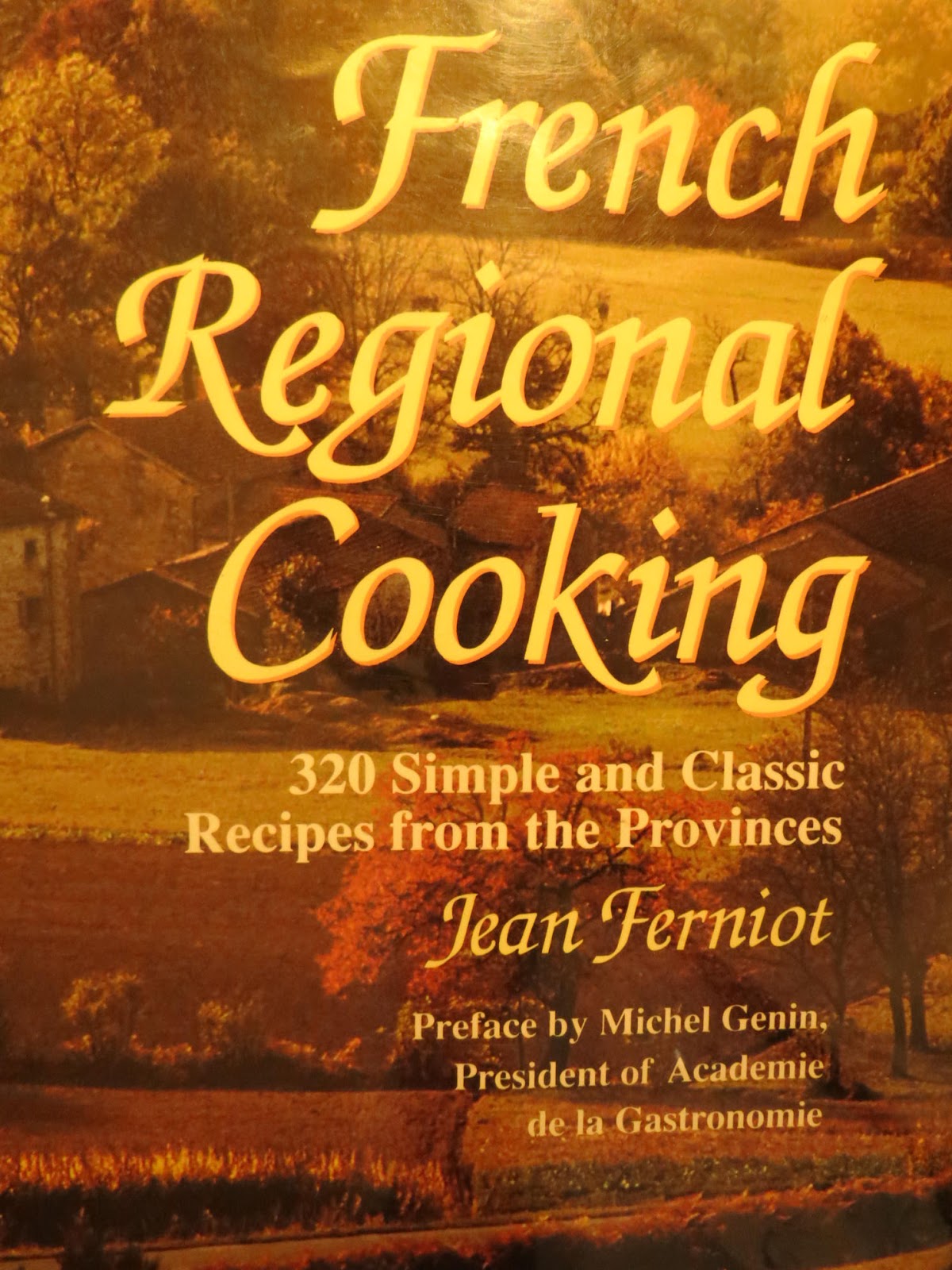
For this year's family reunion dessert, I decided to make what Jayne Robinson calls a Michigan sour cherry pudding cake. My mother and sisters and I agreed that we would call it a Michigan sour cherry custard cake, as the milk and cream and eggs deliver a texture and flavor more like custard than either pudding or cake. French Regional Cooking, by Jean Ferniot, another book I consulted, gives the alternate English/American name as cherry flan. The cherries I used were organic Balatons, and I pitted them hastily before freezing, racing the fruit flies, which explains the appearance of the dessert, both in process and in finished form.

Tart cherries distributed over half the batter in pie pan

Remaining batter poured gently over

Finished dessert, out of the oven

My cookbook of French regional recipes calls this by its traditional French name, clafoutis. It's a specialty of the Massif Central region of France, where I fell in love with the old province of Auvergne, though this recipe comes from the Limousin. Both Jayne's recipe and the French cookbook recipe call for 1/4 cup of heavy cream, but then Jayne uses 3/4 cup of milk and three eggs, while the French leave out the milk entirely and use eight (8) eggs.

French cookbook shows clafoutis made with unpitted cherries

But I did it Jayne's way, and that was a sufficient number of eggs for us. It also let me use whole milk from Shetler's Dairy. The great thing -- a bonus -- about needing heavy cream for the batter was having the remainder to whip for dessert topping. As for the hard stuff, French Regional Cooking called for kirsch, The Cake Chronicles for cognac, but I used Redbreast, because it's what I had on hand, left from a sister visit in August.

The cherries were pitted a few weeks back on my front porch, and my family and I enjoyed our dessert this past weekend on the front porch, but the dessert itself came out of my own little Paris kitchen. It tasted even better than it looked.