Search This Blog

Showing posts with label friends. Show all posts

Monday, August 1, 2022

NOT "Crackers over the Sink"

Inspired by red gooseberries


One of my friends had her 85th birthday recently, and I decided to make a special birthday dinner for the two of us. We enjoy meals on my front porch together, often remembering when there were four of us, not just two. (We share a lot of memories.) So why not an extra-special evening? And there were those gooseberries, after all, calling for something out of the ordinary.


So I put together a dinner plan starting with dessert, the most ambitious item on my menu:  gooseberry tart. Gooseberries have to be “topped and tailed” (stem and blossom ends removed), which is time-consuming but also a basically meditative task perfect for a summer afternoon. Instead of adding sugar to the berries, I mixed in about a third of a little jar of plum jam.


For the shell, I looked at half a dozen recipes and cobbled mine together from bits and pieces of all of them. I didn’t have almonds to grind for the pastry (that would be nice another time) but did have powdered sugar. And we might as well say here that this pastry is known as pâte sucrée. Chunks of butter worked with fingers into flour, sugar, and a pinch of salt, and I added a whole egg (though some people use only the yolk or no egg at all). While the sweet dough rested in the refrigerator, I worked outside in the yard for an hour, planting what will be a lovely daylily border, I’m sure, when the plants fill in. 


Later, while prebaking the tart shell I cooked a batch of rigatoni, and you could call what I made with it mac ‘n’ cheese, I suppose, at least a variation thereon: basic bechamel sauce but made with cream rather than milk and fresh nutmeg grated in; then, for the cheese, raclette. We are very fortunate to have fine raclette made right here on the peninsula at Leelanau Cheese, and I’d bought that at the farmers market on Friday, too. My cheesy pasta I baked in cute little ramekins, with extra raclette on top, but the cuteness was nothing compared to the taste. I warned my friend, “One bite, and you’ll feel a need to go to confession!” She laughed but agreed after she tasted.


We had the salad I invented a couple weeks ago and love for its cool, freshing summer tastes and textures: tomato (this one an heirloom variety from the farmers market), cucumber, blueberries, and pinenuts, with balsamic vinaigrette. We had poached (steamed, really) salmon and green beans with curried mayonnaise, with the rigatoni-raclette on the side. And for dessert we had gooseberry tart generously heaped with freshly whipped real cream.


(Cold, the next day)


Half-eaten serving!


Another friend told me the other day that someone had asked her, after her husband died, if she was fixing regular meals for herself or “eating crackers over the sink.” I certainly don’t fix meals like this when I’m alone (or even for company more than once a year, if that!), but once in a blue moon, for an old friend, it felt like the right time to pull out all the stops -- which meant I also did better than crackers over the sink the following day, when my next evening's dinner recapitulated everything but the whipped cream and so, finally, I got a few half-decent photos to illustrate this post. Because while I often photograph while I'm in the process of cooking and baking, I also often forget to photograph the finished dishes in all their glory. "Did you take a picture of that?" the Artist used to ask me. But now no one asks.


Monday, May 1, 2017

Thirty Years Ago Today


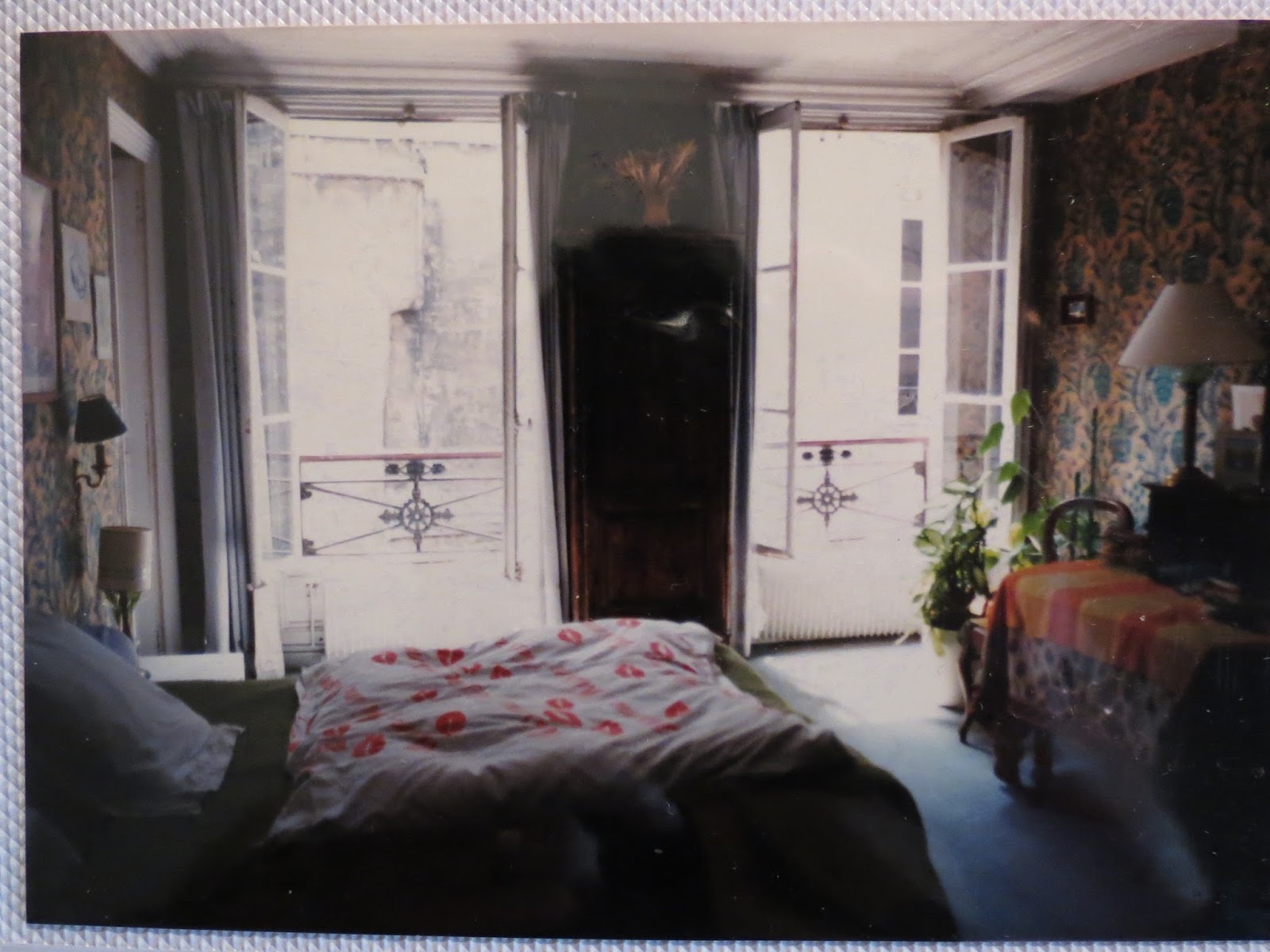
Thirty years ago this morning I awoke in Paris to the sounds of cooing pigeons and the voices of Frenchwomen at their morning household chores coming through tall bedroom courtyard windows. On the nightstand beside my bed was a pot of lilies-of-the-valley. I had arrived at midnight the night before, exhausted after two nights without sleep, a transatlantic flight, hours crouched on the floor of the railroad station in Luxembourg (waiting room with benches only for first-class passengers), a train ride made mostly on my feet (I had a ticket but not a seat reservation), and, after a confusing taxi ride in the dark, a climb with heavy bag to the third floor of 39 rue Vaugirard, where I found a note on the door telling me that Mme. Pillet was downstairs at a friend’s apartment. Down I trudged to find her. Back up again. Did I want something to eat? Wasn’t I hungry? No, I needed to fall into bed as quickly as possible before I keeled over onto the floor!

In the morning I woke refreshed. It was a sunny morning. The soft pigeon sounds, the flute-y women’s voices, the sweet chink of spoons against china cups—purling, murmuring--seemed too beautiful to be real.


Hélène made coffee for me that first morning but warned me she would not do so regularly. She did, however, as she realized I would not be a slovenly renter, extend to me kitchen privileges not accorded to all who stayed in the room, and by the end of the month, when it came time for me to leave, we were close friends.

Being there. Nothing at all like looking at pictures or watching a movie or reading a book or imagining! The ancient city filled with lilies-of-the-valley, pots and bouquets and corsages of them everywhere. The Seine sparkling in the sun.

And so on May Day I remember that morning 30 years ago. A day to celebrate friendship, a holiday from work. For me, a dream come true that lives on, cherished, in memory.


Monday, January 9, 2017

Winter Fare: Gophers and Stone Soup

Stones at mouth of Hurricane River


I was just kidding about the gophers. What I mean is waffles.

Warming plate while waffle iron heats

In Paris, France, waffles are street food. Hot gaufres are served up by vendors in parks who sell their food out of little carts, small mobile kitchens. Like ice cream cones, gaufres are favorite treats of small children but enjoyed by adults, also, perhaps especially by visitors from the American Midwest, to whom street food is a novelty. A favorite French waffle topping – there are many, but this was my favorite -- is almond paste, smeared on like peanut butter on crackers, then sprinkled with powdered sugar.

Out of curiosity, I checked in my French cookbook to see if it even contained a recipe for waffles. Would anyone in Paris ever make them at home? Well, there was a recipe, in fact, but in the section on cakes, on the page opposite fruit cake and jelly roll. It calls for fresh yeast rather than baking powder and also, to my surprise, includes rum, an addition that would never have occurred to me.


Last yummy bite!
For Americans at home in our own country, waffles are breakfast food, but they are a sweet treat here, too. The small, square depressions produced by the iron form a dozen or more tiny receptacles for melted butter and syrup. Jam is a delicious variant topping, and then no fork is needed. Dreaming of Paris, one can pick up a waffle section with fingers, confident of capturing every last morsel of confiture de pêches (thank you, Ed!) or, when that’s gone, good old Michigan strawberry-rhubarb jelly.

We are not talking here about an everyday breakfast, of course. Not the beginning of an ordinary workday. It’s holidays and Sundays that call out for the extra sybaritic excitement only waffles can bring to an otherwise cold, bleak winter morning.

Outdoors the temperature rests, stubbornly, well below the freezing mark, and wind blows fresh snow into blinding drifts. A frigid Sunday morning in January! What better day to stay home by the fireside with dog and books and movies?

Beautiful, beantiful beans!

More stones
Meanwhile, in the big cast iron pot that rested overnight on the cold porch is the bean soup that will be the evening’s hearty peasant supper. On Friday night, as I first covered the colorful beans with water to begin soaking, I thought again, as I have so often before, that they are as beautiful as wave-washed stones on the shores of Lake Superior. Stone soup? Why not? Dry beans lose their bright colors when cooked, but the flavors that develop are worth the trade-off.

Slow cooking. David is always encouraging me to use an electric slow cooker for dishes like bean soup or stewed chicken, but I resist. There is something about that ceramic pot and the way its unlifted lid -- one is instructed rather severely not to lift the lid during cooking! – the way, I say, that lid holds in all the dish’s moisture that, to my way of thinking, prevents precisely the rich, concentrated flavors that are my goal. -- Oh, dear, my italics are running away with me, escaping from foreign words and phrases to the equivalent of a raising of the voice! Yes, it’s true, my emotions are involved!

Where was I? Ah, yes, concentrated flavor.... And besides that, I like to lift the lid! I like to stir the contents of the pot! Stirring the pot makes me think of my grandmother at the stove, and I love remembering my grandmother! I even like to leave the lid off for periods of the cooking process as the bean liquor thickens and steam rises and an alluring aroma fills the old farmhouse. These are some of the joys of winter in Michigan: tastes and smells and leisurely activities mingled with memories.

Far from Paris, you see, I carry that city in my heart, along with the U.P. and Ohio and the Illinois prairie and the Arizona cow country and every other place I have ever lived and cooked and eaten, and in my mind’s eye I see again long-vanished scenes and am warmed by thoughts of family and friends and even strangers who shared those bygone days.

What is the point of having a day to spend at home if I am to deny myself the pleasure of stirring the pot?

Well-stirred bean soup


Friday, April 29, 2016

A Friend's First Trip

My friend Ed is going to France for the first time in June, not only seeing the sights but also studying French and taking a cooking class. You'll be able to follow his adventures here. I certainly plan to tag along via his blog.

Sunday, March 6, 2016

Senses in the Kitchen, at Work and at Play


No doubt synesthesia was born long ago in the wild past of our early evolution, but it is just as surely reborn in the kitchen. When you see fat leeks in the grocery store produce section or smell the earthy freshness of dainty wild ones in the woods, don’t you already feel their smoothness in your mouth? What about the color? My eyes see green, but my mind reads purple, the smooth purple of an eggplant, and my ears hear the rich, dark music of a bassoon or a cello.

Leeks, along with daffodils, are associated by the Welsh with the Feast of St. David on March first. I missed the day again this year. The first of March is too early to look for leeks and daffodils in northern Michigan. So let’s come back indoors, back into the kitchen, and sift through memories and towels.

I am hopeless when it comes to sewing. My mother loved to sew – sewed new dresses for my sisters and me all the time when we were little -- and couldn’t understand how trying to follow a pattern could reduce me to tears. I was proud of my skill in threading the machine, both top and bottom threads, but had not joined 4-H in order to make aprons and skirts! In my mind, 4-H membership was the first step to getting a horse!
Horses = Heaven!
Sewing = Heaven’s Opposite!


Not realizing the difference between farm clubs and city clubs, I was in for a big disappointment. Anyway, it’s impossible to sew and read a book at the same time. I’m talking about real books, with pages to turn. So other than replacing the occasional button, I don’t sew.

And yet, I adore fabric. Beautiful fabric with a good “hand”  attracts and pleases me. I love those very thin, very lightweight cotton shirts that feel like silk against the skin, and I love soft cotton tea towels and much-washed tablecloths. Old-fashioned potholders and “dishrags” made by friends cleverer than I am with their hands increase my pleasure in the kitchen.


Kitchen work, I believe, is such joy because it engages all the senses, along with the hands and the mind. (Somehow I don’t resent putting down a book to work in the kitchen.) Fresh ingredients and finished dishes delight the eye, and anything sizzling in a skillet calls the ears into play, as does the plop-plop-plop of cranberries in a saucepan. Aromas, ah! There are even smells other than those of the food: my electric blender, for instance, gives off metallic whiffs I associate with our old family electric train of childhood.

As for taste, that hardly needs to be mentioned, does it? But touch, too frequently given short shrift in kitchen writing, is for me a principal element of cooking’s joy. Touch comes into play most obviously in the making of bread, as kneading bread dough brings together the work of eyes, nose, and hands. Piecrust requires a lighter touch, but the rolling out of the dough, folding and lifting and fitting to the pan, and finally the fluting of the crust’s boundaries with fingers and thumbs all call for direct unmediated contact of hands with material. 

Besides handling food, washing dishes in hot, soapy water and taking up a soft cotton towel to dry them bring feelings of deep luxury and an opportunity for peaceful meditation that would be ruled out by a dictatorial dishwashing machine. Fortunately, there’s no room in my little Paris kitchen for such a machine.

And let’s bring Paris into our musings before we part company for the day. Do you eat asparagus with knife and fork? Next time, try picking a spear up with your fingers for that first bite from the tender tip. You may dip in melted butter or lemon juice of Hollandaise – or nothing at all! My dear Parisian landlady and friend gave me permission to eat asparagus with my fingers at one of our first dinners together, and with that gesture we celebrated our common peasant heritage. I do it now both for the tactile pleasure and in memory of my old friend.

Once in my presence a little French boy was reprimanded for eating with his fingers, “like a wild tiger,” as his mother put it. The phrase captivated me. Moi, je mange comme un tigre sauvage!

There is still snow on the ground, but soon we will have wild leeks and fresh local asparagus again....


Wednesday, February 17, 2016

Little Things

Loose change


Here’s a sad truth: I have not been back to France since the adoption of the euro. Another truth, not sad at all, to my mind: I have never in France during the winter. Spring, summer, fall, yes. Never winter.

The street markets, like the one on the rue de Buci, and all the little food shops that spread out onto the sidewalk along the rue des Martyrs -- what happens to them in the winter? I never thought to ask. Who can tell me?

On my first visit to Paris I rented a room for a month and was charmed by every little thing I encountered. The landlady’s hand-lettered sign on the apartment door: “Attention au chat,” for instance. With my love of the French language, it didn’t take much to put me in raptures. Another example. Space had been cleared for my things in the closet in my room (you see what a luxurious apartment this had once been, in that it had closets), but up above, on shelves, were large cardboard boxes marked “Vêtements d’été” and “Vêtements d’hiver.” My landlady (who became a dear lifetime friend) would have been astonished had she known how many times I smiled at those boxes and quietly whispered to myself the magic phrases (“Summer clothes” and “Winter clothes”).

Little things. Another dear friend, with whom I have exchanged only handwritten letters for almost thirty years, occasionally encloses in her letters a page from her daily Zen calendar. The last one she sent was from January 18 and reads: “Blessed are they who see beautiful things in humble places where other people see nothing.” It went along with a little pep talk she had given me in her letter. Sometimes I need a pep talk, especially in winter, a season that often finds us, here in the old farmhouse, “down to seeds and stems,” as I used to say until someone told me that was a drug reference. Now I say instead, “We’re eating our seed corn.” The image is different, the reality no easier. But I do find comforts in my little farmhouse kitchen, my Paris kitchen, as I call it, and I love being able to bring comfort from the kitchen to the farmhouse table.

Shallots and garlic

Garlic, ginger, and shallots. Those are certainly little things, but they pack a punch, especially the garlic and ginger. Shallots are more delicate and deserve to be showcased rather than overpowered by stronger flavors. I won’t be discussing them further today but couldn’t resist photographing them with the heads of garlic....

Here’s a tip: If you keep a gingerroot in the freezer and only take it out when you need fresh ginger, you’ll find it easy to pare and grate. Take from the freezer as well some of that garden squash you harvested, roasted, and mashed before the snow began to fly. Ginger will perk up the squash like magic, along with cumin and curry powder. (Spice jars and tins – more wonderful little things!) Finally, either chicken broth or coconut milk or some of both turns vegetable and spices into a beautiful and warming dinner starter.

Other soups are a meal in themselves. One evening while preparing that night’s dinner I also made meatballs with fresh-ground Italian sausage, bread crumbs (homemade honey whole-wheat bread), egg, and I forget now what-else. Put the meatballs on a cookie sheet, spaced so as not to touch, and baked them in the oven instead of using a skillet, in order to have time and space to continue the more imminent meal. Intended for a future meal, they could have been frozen, but this time I put them in the refrigerator to use the next day.

The following day, however, I did go to the freezer for scraps of vegetable ends and peelings and leftover chicken bits to simmer in water with onion and garlic for hours, making a good broth. 


Late in the day -- limp, soggy vegetable matter moved on to compost collection -- I added diced tomatoes and rinsed cannellini beans to the broth and sprinkled with herbes de Provence. (Cooking in stages means being able to clean up as one goes along, very important in the small kitchen.) A generous handful of farfalle (bow tie pasta) I cooked separately in water, then drained and tossed back into its pan with a little bit of olive oil.

The addition of Italian sausage meatballs and farfalle gave the finished soup a hearty winter heft. When one broke into a meatball with a spoon, new flavors were released into the broth, and all the little things came together in a most satisfying way. And two or three meatballs per bowl of soup suffice, so a single batch of meatballs will stretch over at least three meals – more, if you live alone.


 “Little drops of water, little grains of sand.” A little ginger, a little garlic. Little blessing from friends to brighten dark winter days.


Sunday, December 6, 2015

On the rue de Vaugirard


Au coin

Forgive the poor quality of this first image, cropped and blown up from a full-size print, itself of unexceptional quality. It was on the rue de Vaugirard (the longest street in Paris, my taxi driver warned when I gave him the street number, he trying to ascertain that I really did know where I was going), in the sixth arrondissement, that I encountered my first Paris kitchen. It was the kitchen of the first apartment I ever saw in Paris, the first Paris building I’d ever been in other than the train station, le gare du Nord.

For years I had been hoarding a few days a year of vacation time, never spending all I had available, until at last I had enough vacation time to go to Paris – for the first time! – for an entire month. All alone! I was going to have, at last, an adventure I had dreamed of all my life. “Where are you staying?” one friend asked. Airily I dismissed the question. I would find a hotel when I got there. The friend was aghast. Most of my friends were aghast, truth be told. One person, I was told years later, predicted that the city would “eat her alive.” “Her” being me, of course. Others told me I would hate Paris because Parisians were rude and hated Americans. I dismissed that silliness out of hand, sure that Parisians would love me, because I would be so happy to be there.

I did not take Paris by storm, but on that first visit I formed a friendship with a woman of my parents’ generation, a friendship that endured to the death.

Back home, the friend who had asked where I would be staying had been in Paris the previous year, and he contacted a woman from whom he had rented a room, although I already had plane tickets and would be arriving on the last day of April (2007), to stay through the month of May, whether or not that particular room might be available. Madame replied that she had only one month still available for the entire year – the month of May. I was in!

It was an exhausting flight on Icelandair, from Chicago via Keflavik to Luxemburg, where there was a long layover in a train station with waiting room seating accommodations only for first-class passengers. I hunkered down on the floor with my bag, willing the hands of the clock to move. Hours later the train to Paris began boarding, but I still had nowhere to sit: I had a ticket to ride but no “reservation,” a separate expense that would have guaranteed me a seat. Without a reservation I had to stand up, exhausted, swaying, almost until my destination was reached.

Midnight. Back in Michigan it was 7 a.m. I had been awake for two nights already. Yes, I assured the taxi driver, I was certain of the house number. And I had the all-important code that would get me into the building.

Un escargot
A beautiful stairway led up to the apartment of Madame Hélène P. Up and up and up I went with what now felt like a bag of cement. On her door was a little handwritten note, saying she was downstairs on the first floor, visiting a friend! I staggered back down, taking the bag along, unfamiliar with the city and the building and its inhabitants and customs. Mme. P. and her friend, Mme. L., tried to urge on me a cup of tea, a bite of something to eat, but all I had strength to do was to fall on a bed, and so, back upstairs and into – my room!


The room she rented out by the month – under the table, bien sûr, since the apartment was rent-controlled but because only with the income from the room could she manage to survive – was much larger and more generously furnished than her own bedroom. I had what seemed an enormous bed with small tables on each side, a fireplace surmounted by a mirror, a large table for writing, and a closet. The bathroom, c’est-à-dire, la salle de bain (not la toilette, which was in a separate, small, windowless room on the other side of the kitchen), with large tub and shower and bidet and window and rack for drying hand-laundered items, was between the two bedrooms, but my landlady seemed to regard it as mine, for some reason. Because I was a paying guest. When she asked me once, apologetically, if she might have a bath, I was shocked. “Mais vous êtes chez vous!” I told her. It was her home! And yet, dependent on her sub rosa rental income, she wanted her renter to be happy.

Hélène et Sirius, son chat
How could I not be happy? That first morning, hearing French voices through the open windows, the thrilling, chinking sound of spoon against coffee cup, the cooing and purling of pigeons and occasional flutter of their wings!

I would go out every morning, having studied my map and bus schedules and chosen a direction and one or more destinations for the day, but I only took a camera with me two or three times, near the end of my time there, because more than anything else I wanted to be where I was, immersed in the sensations of the moment and not viewing objectively through a mechanical lens. In the evenings, Mme. P. and I would sit together at her dining table, which also held her small television set, and she would watch tennis matches or work crossword puzzles, and I would write letters home, but our conversations gradually became more important to both of us. Hélène spoke no English, which was ideal from my perspective, as it forced me to rely on and improve the high school French I had been struggling to retain for so many years. We generally had a dictionary or two on the table between us, as well as a pad of “bloc-notes,” that peculiar paper the French seem to favor which instead of being simply lined for writing is broken up into a blue grid of small squares. If either of us could not make out what the other was trying to say, we would resort to pen and paper.

I saw myself in that era of my life as remarkably independent and self-sufficient. Hadn’t I gotten myself across the Atlantic Ocean, and wasn’t I making my way around a cosmopolitan world city day after day, all alone, in an acquired second language? Mme. P. saw me, I later learned, as “fragile,” and in a number of small ways she took me under her wing. When I brought home a bottle of red wine one evening, wine I thought incredibly cheap, she told me not to waste my money so extravagantly, that she would keep a bottle filled for me from her supply of bulk wine. She cleared a shelf in the refrigerator for me and kept a bottle filled with wine for me on that shelf. Next she offered to take me to the nearest neighborhood produce market, her favorite, one alas! now replaced by modern apartments. And after carefully noting my generally frugal (apart from that first bottle of wine) and tidy ways, she extended kitchen privileges to me. Cooking in Hélène’s kitchen did not come automatically with room rental. It was a privilege that had to be earned.

Another “alas!” is that I have no photographs of the kitchen, nor did I keep any kind of record of what I cooked in it. I remember an artichoke one evening. Another time I returned alone to the market Hélène had introduced me to and requested an avocado of a Vietnamese vendor. “Pour manger quand?” he asked. When I intended to eat the avocado determined the one he would choose for me. I also had a little beguin (a weakness) for all kinds of French sausages and related products. The variety dazzled me.

Later I would come to know the wonderful market street of the ninth arrondissement, la rue des Martyrs, and when to pronounce or not pronounce the final ‘s’ of the word plus when buying a tranche of cheese, the difference being more or no more.

Fromages!!!

About halfway through May, Hélène and I had progressed to addressing one another by the familiar tu, and it’s hard to say which of us was more touched by the conversational intimacy. For me it marked a first; for her, it might have been one of the last. When I returned to Michigan, we began an exchange of letters. And earlier this year, when I plucked I Know How to Cook, the English translation of the basic French cookbook, Je sais cuisiner, off my shelf, out fell letters from Paris.


I was transported. My friend, who died at the age of 90 about a decade ago, was alive again as I re-read the letters. The last one, I realized more than I had when first I received it, was one she knew would probably be the last she would write to me. It expressed how deeply she valued our friendship, how much I meant to her, but she also admitted that she had little desire any more for her own life, that she had become “a bit of a spectator of the end of [her] life” (un peu spectateur de ma fin de vie), though she retained her love of nature – the sky, clouds, cats, and “animals in general.” Always she closed sending kisses to my dog, a dog she knew only from snapshots.

I saw her last in September 2000, but Hélène is with me still, in my little Paris kitchen in my old Michigan farmhouse. It was Hélène who encouraged me to eat asparagus with my fingers, peasant-style (Hélène was artistic, well read, politically and socially well informed, and the same year I met her I began graduate studies in philosophy, but both of us came from peasant stock and were proud of that heritage), and even now, in spring, when Michigan asparagus is so tender and green, I wish I could have introduced my Parisian friend to the way we know the vegetable here Up North.

Ma chère amie, Hélène, tu es encore dans mon coeur et vraiment dans ma vie quotidienne. Quand je faire du pain, quand je bois du vin, je pense à toi.

The kitchen in my Michigan farmhouse, small as it is, overflows with dear, ghostly presences, and for that I am grateful. I would not have it any less crowded for the world. Here is the pasta maker given to me by another friend back in the 1970s. I think of her every time I use it. She died this year, but she also is alive in my Paris kitchen.

Pasta maker from Linda

Homemade noodles

Noodles and gravy